DEF 14A: Definitive proxy statements
Published on April 21, 2026
UNITED STATES
SECURITIES AND EXCHANGE COMMISSION
Washington, D.C. 20549
SCHEDULE 14A
(Rule 14a-101)
INFORMATION REQUIRED IN PROXY STATEMENT
SCHEDULE 14A INFORMATION
Proxy Statement Pursuant to Section 14(a) of the
Securities Exchange Act of 1934
(Amendment No. )
Filed by the Registrant x
Filed by a party other than the Registrant o
Check the appropriate box:
| o | Preliminary Proxy Statement | |||||||
| o | Confidential, for Use of the Commission Only (as permitted by Rule 14a-6(e)(2)) | |||||||
| x | Definitive Proxy Statement | |||||||
| o | Definitive Additional Materials | |||||||
| o | Soliciting Material under § 240.14a-12 | |||||||
(Name of Registrant as Specified In Its Charter)
(Name of Person(s) Filing Proxy Statement, if other than the Registrant)
Payment of Filing Fee (Check all boxes that apply):
| x | No fee required | |||||||
| o | Fee paid previously with preliminary materials | |||||||
| o | Fee computed on table in exhibit required by Item 25(b) per Exchange Act Rules 14a-6(i)(1) and 0-11 | |||||||

Abacus Global Management, Inc.
2101 Park Center Drive, Suite 200
Orlando, Florida 32835
NOTICE OF ANNUAL MEETING OF STOCKHOLDERS
To Be Held on June 3, 2026
Dear Stockholder:
We are pleased to invite you to attend the 2026 Annual Meeting of Stockholders (including any adjournments, continuations or postponements thereof, the “Annual Meeting”) of Abacus Global Management, Inc., a Delaware corporation (“Abacus”, “Company”, or “we”), which will be held at 4:00 p.m. (Eastern Time). This year’s Annual Meeting will be conducted virtually via live audio webcast. You will be able to attend the meeting, submit questions, and vote your shares online by visiting www.virtualshareholdermeeting.com/ABX2026 and logging in using the 16-digit control number included on your proxy card or the voting instruction form received from your bank or broker. Once you have logged in to the virtual meeting, you will be able to submit questions and vote your shares electronically during the Annual Meeting.
The Annual Meeting will be held for the following purposes, which are more fully described in the accompanying materials:
(1)To elect two Class III directors, Jay Jackson and Thomas W. Corbett, Jr., to hold office until our annual meeting of stockholders in 2029 and until their successors are duly elected and qualified, or until their earlier death, resignation or removal;
(1)To ratify the selection of KPMG LLP as our independent registered public accounting firm for the fiscal year ending December 31, 2026;
(2)To consider and vote to adopt the Abacus Global Management, Inc. 2026 Long-Term Equity Incentive Plan;
(3)To conduct an advisory vote to approve the compensation of our named executive officers (“Say-on-Pay”);
(4)To consider an advisory vote to determine stockholder preference on the frequency of the Say-on-Pay vote; and
(5)To conduct any other business properly brought before the Annual Meeting.
Holders of record of our outstanding shares of common stock (“Common Stock”) at the close of business on April 20, 2026, are entitled to notice of and to vote at the Annual Meeting, or any continuation, postponement or adjournment of the Annual Meeting. The Annual Meeting may be continued or adjourned from time to time without notice other than by announcement at the Annual Meeting.
Important Notice Regarding the Availability of Proxy Materials for the Annual Meeting of Shareholders to Be Held on June 3, 2026
We have elected to provide our stockholders with a full set of printed proxy materials by mail, which includes the proxy statement for our Annual Meeting (“Proxy Statement”) accompanying this notice. On or about April 23, 2026, we expect to begin mailing to our stockholders of record the Proxy Statement, accompanying proxy card and our Annual Report on Form 10-K for the fiscal year ended December 31, 2025 (“2025 Annual Report”). The Proxy Statement and our 2025 Annual Report can be accessed directly at the internet address www.proxyvote.com using the control number located on the Notice, on your proxy card or in the instructions that accompanied your proxy materials. If you are stockholder as of the record date and for any reason did not receive, or you require additional copies of, the proxy materials, you may request them at no cost to you by writing to: 2101 Park Center Drive, Suite 200, ATTN: Corporate Secretary, Orlando, FL 32835, by email to: legal@abacusgm.com, or by telephone at (800) 561-4148.
Your vote is important. Whether or not you plan to attend the Annual Meeting, we hope you will vote by internet, telephone or mail as soon as possible to ensure your vote is recorded promptly. Please carefully review the instructions on each of your voting options described in the Proxy Statement, as well as in the accompanying Notice of Internet Availability of Proxy Materials, proxy card or voting instruction form.
By Order of the Board of Directors
Jay Jackson
Chairman of the Board and Chief Executive Officer
ABACUS GLOBAL MANAGEMENT, INC.
PROXY STATEMENT FOR 2026 ANNUAL MEETING OF STOCKHOLDERS
TABLE OF CONTENTS
SPECIAL NOTE REGARDING FORWARD-LOOKING STATEMENTS
This Proxy Statement on Schedule 14A (this “Proxy Statement”) contains forward-looking statements within the meaning of Section 27A of the Securities Act of 1933, as amended (the “Securities Act”), and Section 21E of the Securities Exchange Act of 1934, as amended (the “Exchange Act”), which statements involve substantial risks and uncertainties. Forward-looking statements generally relate to future events or our future financial or operating performance and may include statements concerning, among other things, our business strategy, our industry, our governance initiatives and impacts of our compensation program.
In some cases, you can identify forward-looking statements by words such as “anticipate,” “believe,” “consider,” “continue,” “could,” “estimate,” “expect,” “intend,” “may,” “plan,” “predict,” “should,” “would,” “possible,” “potential,” “might,” “seek,” or “will” or the negative or plural of these words or other similar terms or expressions. All statements other than statements of historical fact are forward-looking statements, which speak only as of the date they are made, and are not guarantees of future performance.
These forward-looking statements involve a number of assumptions, risks and uncertainties that could cause actual results to differ materially from expected results. As a result, you should not put undue reliance on any forward-looking statement. These forward-looking statements are included throughout this Proxy Statement. Factors that could cause our actual results to differ materially from those expressed or implied in such forward-looking statements include, but are not limited to, the potential impact of our business relationships, including with our employees, customers and competitors; changes in general economic, business and political conditions, including changes in the financial markets; weakness or adverse changes in the level of activity in our sector or the sector of our affiliated companies, which may be caused by, among other things, high and increasing interest rates, or a weak U.S. economy; significant competition that our operating subsidiaries face; compliance with extensive government regulation; and the other risks set forth under “Risk Factors” in our Annual Report on Form 10-K for the fiscal year ended December 31, 2025, which was filed with the Securities and Exchange Commission (the “SEC”) on March 13, 2026 (our “2025 Annual Report”) or elsewhere therein and in our other public filings with the SEC. Although we believe that the expectations reflected in these forward-looking statements are reasonable, we cannot assure that these expectations will prove to be correct and should one or more of these risks or uncertainties materialize, or should any of our assumptions prove to be incorrect, our actual results may vary in material respects from what we may have expressed or implied by these forward-looking statements. We may not actually achieve the plans, intentions, or expectations disclosed in our forward-looking statements, and we caution that you should not place undue reliance on any of our forward-looking statements. Any forward-looking statement made by us in this Proxy Statement speaks only as of the date on which we make it. We undertake no obligation to publicly update any forward-looking statement, whether as a result of new information, future developments or otherwise, except as may be required by applicable securities laws. You should read this Proxy Statement with the understanding that our actual future results, performance, and events and circumstances may be materially different from what we expect.
i
ABACUS GLOBAL MANAGEMENT, INC.
2101 Park Center Drive, Suite 200
Orlando, Florida 32835
PROXY STATEMENT
FOR THE 2026 ANNUAL MEETING OF STOCKHOLDERS
To Be Held on June 3, 2026 at 4:00 p.m. (Eastern Time)
Our board of directors is soliciting your proxy to vote at the 2026 Annual Meeting of Stockholders (including any adjournments, continuations or postponements thereof, the “Annual Meeting”) of Abacus Global Management, Inc., for the purposes set forth in this Proxy Statement. If you held shares of our Common Stock as of the close of business on April 20, 2026 (the "Record Date"), you are entitled to vote on the proposals described in this Proxy Statement. This Proxy Statement includes information that we are required to provide to you under the rules of the SEC and that is designed to assist you in voting your shares. The Annual Meeting will be held virtually on June 3, 2026 at 4:00 p.m. (Eastern Time). This year’s Annual Meeting will be conducted virtually, via live audio webcast. You will be able to attend the meeting online by visiting www.virtualshareholdermeeting.com/ABX2026. You will be able to submit questions and vote your shares electronically during the meeting by logging in using the 16-digit control number included on your proxy card or the voting instruction form received from your bank or broker. Once you have logged in to the virtual meeting, you will be able to submit questions and vote your shares electronically during the Annual Meeting.
In this Proxy Statement, we refer to Abacus Global Management, Inc. (including its consolidated subsidiaries) as “Abacus,” “we,” “us” or “our” and the board of directors of Abacus as “our board of directors.” We have elected to provide stockholders as of the Record Date with a full set of printed proxy materials by mail. On or about April 23, 2026, we began mailing this Proxy Statement, the accompanying proxy card and our 2025 Annual Report to stockholders of record as of the Record Date.
The information provided in the “question and answer” format below is for your convenience only and is merely a summary of the information contained in this Proxy Statement. You should read this entire Proxy Statement carefully. Information contained on, or that can be accessed through, our website is not intended to be incorporated by reference into this Proxy Statement and references to our website address in this Proxy Statement are inactive textual references only.
Commonly Asked Questions About the Annual Meeting
Why did I receive these Proxy Materials?
You received these proxy materials because, as of the Record Date, you directly or indirectly held, and were entitled to vote, shares of the Company’s common stock. In connection with the Board of Directors’ solicitation of proxies to be voted at the Annual Meeting, we are providing stockholders entitled to vote at the Annual Meeting with this Proxy Statement, the Company’s most recent Annual Report on Form 10-K, and a proxy card or voting instruction form.
Your proxy card or voting instruction form is being provided with a unique control number that allows you to submit your voting instructions electronically via the Internet or by telephone. We refer to these materials collectively as the “Proxy Materials.” The Proxy Materials contain important information about the Company and describe the voting procedures and the matters to be voted on at the Annual Meeting.
1
Householding of Proxy Materials
SEC rules permit companies and intermediaries such as brokers to satisfy delivery requirements with respect to two or more stockholders sharing the same address by delivering a single annual report and proxy statement addressed to those stockholders. This process, which is commonly referred to as “householding,” can reduce the volume of duplicate information received at households. While the Company does not household, a number of brokerage firms with account holders have instituted householding. Once a stockholder has consented or receives notice from their broker that the broker will be householding materials to the stockholder’s address, householding will continue until the stockholder is notified otherwise or until one or more of the stockholders revokes their consent. If your annual report and proxy statement have been househeld and you wish to receive separate copies of these documents now and/or in the future, or if your household is receiving multiple copies of these documents and you wish to request that future deliveries be limited to a single copy, you may notify your broker. You can also request and we will promptly deliver a separate copy of the proxy materials by writing to: 2101 Park Center Drive, Suite 200, ATTN: Corporate Secretary, Orlando, Florida 32835, by email to: legal@abacusgm.com, or by telephone at: (800) 561-4148.
What am I voting on?
There are five matters scheduled for a vote at the Annual Meeting:
•Proposal One: Election of two Class III directors, Jay Jackson and Thomas W. Corbett, Jr., to hold office until our annual meeting of stockholders in 2029 and until their successors are duly elected and qualified, or until their earlier death, resignation or removal;
•Proposal Two: Ratification of the selection of KPMG LLP (“KPMG”) as our independent registered public accounting firm for the fiscal year ending December 31, 2026;
•Proposal Three: Approval of the Abacus Global Management, Inc. 2026 Long-Term Equity Incentive Plan (the “2026 LTIP”);
•Proposal Four: Advisory vote on Executive Compensation; and
•Proposal Five: Advisory Vote on the frequency of the Say-on-Pay Vote.
What are the voting recommendations of our board of directors?
Our board of directors recommends that you vote:
•“FOR” the director nominees named in Proposal One;
•“FOR” the ratification of the selection of KPMG as our independent registered public accounting firm as described in Proposal Two;
•“FOR” the approval of the 2026 LTIP as described in Proposal Three;
•“FOR” the approval, on an advisory basis, of the compensation of the Company's named executive officers as described in Proposal Four; and
•“EVERY 3 YEARS” for, on an advisory basis, the frequency of the future advisory votes to approve named executive officer compensation.
2
Who can vote at the Annual Meeting?
Holders of our Common Stock as of the close of business on the Record Date will be entitled to vote at the Annual Meeting. As of April 20, 2026, there were [95,616,386] shares of our Common Stock outstanding. Holders of our Common Stock will vote on all matters described in this Proxy Statement for which your vote is being solicited. Each share of Common Stock is entitled to one vote on each proposal.
Stockholder of Record: Shares Registered in Your Name. If, as of the close of business on the Record Date, your shares were registered directly in your name with our transfer agent, Continental Stock Transfer & Trust Company, then you are a stockholder of record. As a stockholder of record, you may vote virtually during the Annual Meeting or by proxy in advance. Whether or not you plan to attend the Annual Meeting, we urge you to vote your shares by proxy in advance of the Annual Meeting through the internet, by telephone or by completing and returning a printed proxy card if one is mailed to you.
Beneficial Owner: Shares Held on Your Behalf by a Brokerage Firm, Bank or Other Nominee. If, as of the close of business on the Record Date, your shares were held not in your name, but on your behalf by a brokerage firm, bank or other nominee, then you are the beneficial owner of shares held in “street name” and your proxy materials are being forwarded to you by that nominee. Those shares will be reported as being held by the nominee (e.g., your brokerage firm) in the system of record used for identifying stockholders. As a beneficial owner of the shares, you are invited to attend the Annual Meeting, and you have the right to direct your brokerage firm, bank or other nominee regarding how to vote the shares in your account.
Will a list of stockholders of record as of the Record Date be available?
A list of all stockholders entitled to vote at the Annual Meeting will be available for examination for any purpose relevant to the meeting at our principal executive offices at 2101 Park Center Drive, Suite 200, Orlando, Florida 32835 for ten days before the Annual Meeting. If you would like to schedule an appointment to examine the stockholder list during this period, please email legal@abacusgm.com.
How do I vote?
Stockholder of Record: Shares Registered in Your Name. If you are a stockholder of record, you may vote (i) live during the virtual Annual Meeting or (ii) in advance of the Annual Meeting by proxy through the internet, by telephone or by using a proxy card. Whether or not you plan to attend the Annual Meeting, we urge you to vote by proxy to ensure your vote is counted. Even if you have submitted a proxy before the meeting, you may still attend in person and vote during the meeting. In such case, your previously submitted proxy will be disregarded. For more information, see the question below titled “—Can I change my vote or revoke my proxy after submitting a proxy?”
•To vote during the virtual Annual Meeting, you must access the meeting website at www.virtualshareholdermeeting.com/ABX2026 and enter the 16-digit control number found on the proxy card provided to you with this Proxy Statement, or that is set forth within the body of the email sent to you with the link to this Proxy Statement.
•To vote in advance of the Annual Meeting (i) through the internet, go to www.proxyvote.com to complete an electronic proxy card, or (ii) by telephone, call 1-800-690-6903. You will be asked to provide the control number from the proxy card or instructions that accompanied your proxy materials. Votes over the internet or by telephone must be received by 11:59 p.m. (Eastern Time) on June 2, 2026 to be counted.
3
•To vote in advance of the Annual Meeting using a printed proxy card, simply complete, sign and date the proxy card and return it promptly in the envelope provided. If you return your signed proxy card to us by the close of business on the day prior to the Annual Meeting, we will vote your shares as you direct.
Beneficial Owner: Shares Held on Your Behalf by a Brokerage Firm, Bank, or Other Nominee. If you are a beneficial owner of shares held on your behalf by a brokerage firm, bank or other nominee, you should receive a voting instruction form to vote in advance of the Annual Meeting from that nominee rather than from us. If you hold their shares in street name you should contact your bank, broker, or other nominee (preferably at least five days before the Annual Meeting) to obtain your 16-digit control number in order to attend, participate in, or vote at the Annual Meeting.
How can I attend and participate in the virtual Annual Meeting?
The Annual Meeting is being held as a virtual only meeting this year. You are entitled to attend and participate in the virtual Annual Meeting only if you were a stockholder as of the Record Date or you hold a valid proxy for the virtual Annual Meeting.
If you are a stockholder of record as of the Record Date, you may attend, vote and ask questions virtually at the meeting by logging in at www.virtualshareholdermeeting.com/ABX2026 and entering your 16-digit control number. This number is included in your proxy card.
If you are a stockholder as of the Record Date and have logged in using your 16-digit control number, you may submit questions at any point during the meeting (until the floor is closed to questions) by typing your question into the “Ask a Question” field, and clicking “Submit.” Stockholder questions or comments are welcome, but we will only answer questions pertinent to Annual Meeting matters, subject to time constraints. Questions regarding personal matters and statements of advocacy are not pertinent to Annual Meeting matters and therefore will not be addressed. Questions or comments that are substantially similar may be grouped and answered together to avoid repetition. The audio broadcast of the Annual Meeting will be archived at www.virtualshareholdermeeting.com/ABX2026 for at least one year.
If you are a beneficial stockholder as of the Record Date and own your shares through a brokerage firm, bank or other nominee, in order to participate in the Annual Meeting to ask questions or vote, you should contact your bank, broker, or other nominee (preferably at least five days before the Annual Meeting) to obtain your 16-digit control number in order to be able to attend, participate in, or vote at the Annual Meeting.
If you are not a stockholder as of the Record Date or do not log in using your 16-digit control number, you may still log in as a guest and listen to the Annual Meeting, but you will not be able to ask questions or vote at the meeting.
On the day of the Annual Meeting, June 3, 2026, stockholders of record may begin to log in to the virtual Annual Meeting 15 minutes prior to the Annual Meeting. The Annual Meeting will begin promptly at 4:00 p.m. Eastern Time.
Should you encounter any difficulties accessing the virtual Annual Meeting platform, including any difficulties voting or submitting questions, please contact technical support as indicated on the Annual Meeting sign-in page.
4
A recording of the Annual Meeting will be available following the meeting in the investor relations section of our website at ir.abacusgm.com. The content of our website is not incorporated by reference into this Proxy Statement or in any other report or document we file with the SEC, and any references to our website are intended to be inactive textual references only.
Why is the Annual Meeting virtual only?
We have adopted a virtual format for our Annual Meeting to provide a consistent experience to all stockholders regardless of location. Hosting a virtual meeting makes it easy for our stockholders to participate from any location in the world.
What if I run into technical issues while trying to access the Annual Meeting?
The virtual meeting platform is supported across browsers and devices running the most updated version of applicable software and plug-ins. Participants should give themselves plenty of time to log in and ensure they have a strong internet connection and they can hear streaming audio prior to the start of the Annual Meeting.
If you encounter technical difficulties with the Annual Meeting platform on the meeting day, please call the technical support number that will be posted on the meeting website. Technical support will be available starting at 3:45 p.m. Eastern Time and until the end of the meeting.
Who will count the votes?
Broadridge Financial Services will tabulate and certify the votes. A representative of Abacus may serve as an inspector of election.
How many votes do I have?
Holders of our Common Stock will have one vote per share held as of the close of business on the Record Date. Holders of our Common Stock as of the Record Date will vote on all matters described in this Proxy Statement for which your vote is being solicited.
What if another matter is properly brought before the Annual Meeting?
Our board of directors does not intend to bring any other matters to be voted on at the Annual Meeting, and currently knows of no other matters that will be presented for consideration at the Annual Meeting. If any other matters are properly brought before the Annual Meeting, your proxy holder (one of the individuals named on your proxy card) will vote your shares using his best judgment.
Can I change my vote or revoke my proxy after submitting a proxy?
Yes. If you are a stockholder of record, you can change your vote or revoke your proxy at any time before your proxy is voted at the Annual Meeting in any one of the following ways:
•Submit another properly completed proxy card with a later date.
•Grant a subsequent proxy by telephone or through the internet.
•Send a timely written notice that you are revoking your proxy to our Corporate Secretary at 2101 Park Center Drive, Suite 200, Orlando, Florida 32835, Attention: Corporate Secretary.
5
•Attend the virtual Annual Meeting and vote during the meeting. Simply attending the virtual Annual Meeting will not, by itself, change your vote or revoke your proxy. Even if you plan to attend the Annual Meeting, we recommend that you also submit your proxy or voting instructions or vote in advance of the Annual Meeting by telephone or through the internet so that your vote will be counted if you later decide not to attend the Annual Meeting.
If you are a beneficial owner and your shares are held in “street name” on your behalf by a brokerage firm, bank or other nominee, you should follow the instructions provided by that nominee.
Your most recent proxy card or internet or telephone proxy is the one that is counted. Your attendance at the Annual Meeting by itself will not revoke your proxy unless you give written notice of revocation to the Corporate Secretary before your proxy is voted or you vote at the virtual Annual Meeting.
If I am a stockholder of record and I do not vote, or if I return a proxy card or otherwise vote without giving specific voting instructions, what happens?
If you are a stockholder of record and do not vote through the internet, by telephone, by completing a proxy card or in person during the Annual Meeting, your shares will not be voted.
If you return a signed and dated proxy card or otherwise vote without marking voting selections, your shares will be voted in accordance with our board of directors’ recommendations:
•“FOR” the election of the two Class III director nominees;
•“FOR” the ratification of the selection of KPMG as our independent registered public accounting firm for the fiscal year ending December 31, 2026.
•“FOR” the approval of the 2026 LTIP;
•“FOR” the approval, on an advisory basis, of the compensation of our named executive officers; and
•“EVERY 3 YEARS” for, on an advisory basis, the option that calls for future Say-on-Pay votes to be held every "3 Years".
If any other matter is properly presented at the Annual Meeting, your proxy holder (one of the individuals named on your proxy card) will vote your shares using his best judgment.
If I am a beneficial owner of shares held in “street name” and I do not provide my brokerage firm, bank or other nominee with voting instructions, what happens?
If you are a beneficial owner and do not instruct your brokerage firm, bank or other nominee how to vote your shares, your shares will be considered “uninstructed” and the question of whether your nominee will still be able to vote your shares depends on whether, pursuant to stock exchange rules, the particular proposal is deemed to be a “routine” matter. Brokerage firms, banks and other nominees can use their discretion to vote “uninstructed” shares with respect to matters that are considered to be “routine,” but not with respect to “non-routine” matters. Under applicable rules and interpretations, “non-routine” matters are matters that may substantially affect the rights or privileges of stockholders, such as elections of directors (even if not contested), mergers, stockholder proposals, executive compensation and certain corporate governance proposals, even if management-supported. The only routine matter to be presented at our Annual Meeting is the proposal to ratify the appointment of KPMG as our independent registered public accounting firm for the fiscal year ending
6
December 31, 2026 (Proposal Two). Rules applicable to brokers consider uncontested elections of directors, matters related to executive compensation, and matters related to corporate governance to be non-routine.
Accordingly, your brokerage firm, bank or other nominee may vote your shares on Proposal Two, which is considered “routine,” without your instructions. Your brokerage firm, bank or other nominee may not, however, vote your shares on Proposal One, Proposal Three, Proposal Four, or Proposal Five without your instructions, which would result in a “broker non-vote” and your shares would not be counted as having been voted on Proposal One Proposal Three, Proposal Four, or Proposal Five. Please instruct your brokerage firm, bank or other nominee to ensure that your vote will be counted. As Proposal Two is considered a “routine” matter, we do not expect “broker non-votes” to exist in connection with this proposal.
If you are a beneficial owner of shares held in street name, and you do not plan to attend the Annual Meeting, in order to ensure your shares are voted in the way you would prefer, you must provide voting instructions to your brokerage firm, bank or other nominee by the deadline provided in the materials you receive from your nominee.
What are “broker non-votes”?
As discussed above, when a beneficial owner of shares held in “street name” does not give instructions to the brokerage firm, bank or other nominee holding the shares as to how to vote on matters deemed to be “non-routine,” the brokerage firm, bank or other nominee cannot vote the shares. These unvoted shares are counted as “broker non-votes.”
How many votes are needed to approve each proposal?
Proposal One. Directors are elected by a plurality of the votes cast by the stockholders present in person or represented by proxy at the meeting and entitled to vote thereon. “Plurality” means that the two Class III director nominees who receive the largest number of votes cast “FOR” such nominees will be elected as directors. As a result, any shares not voted “FOR” a particular nominee, whether as a result of a “WITHHOLD” vote or a broker non-vote (in other words, where a brokerage firm has not received voting instructions from the beneficial owner and for which the brokerage firm does not have discretionary power to vote on a particular matter), will not be counted in such nominee’s favor and will have no effect on the outcome of the election. You may vote “FOR” or “WITHHOLD” on the two Class III director nominees.
Proposal Two. The ratification of the selection of KPMG as our independent registered public accounting firm for the fiscal year ending December 31, 2026 requires the majority of the votes cast by the stockholders present in person or represented by proxy at the meeting and entitled to vote thereon. Abstentions represent a stockholder’s affirmative choice to decline to vote on a proposal. Abstentions will be counted as present and entitled to vote on Proposal Two and will therefore have the effect of a vote “AGAINST” Proposal Two. Because this is a “routine” proposal, no broker non-votes are expected to result from this proposal.
Proposal Three. The approval of the 2026 LTIP requires the majority of the votes cast by the stockholders present in person or represented by proxy at the meeting and entitled to vote thereon. Abstentions will be counted as present and entitled to vote on Proposal Three and will therefore have the effect of a vote “AGAINST” Proposal Three. Broker non-votes will not be entitled to vote on Proposal Three and will therefore have no effect on Proposal Three.
Proposal Four. The approval, on an advisory basis, the compensation of our named executive officers requires the majority of the votes cast by the stockholders present in person or represented by proxy at the
7
meeting and entitled to vote thereon. Abstentions will be counted as present and entitled to vote on Proposal Four and will therefore have the effect of a vote “AGAINST” Proposal Four. Broker non-votes will not be entitled to vote on Proposal Four and will therefore have no effect on Proposal Four.
Proposal Five. In the case of Proposal Five, the approval, on an advisory basis, the frequency of future votes on the compensation of our named executive officers, the frequency that receives the highest number of votes cast by the stockholders present in person or represented by proxy at the meeting and entitled to vote thereon will be deemed to be the frequency selected by shareholders. Shareholders may vote their preference as to whether to include such proposals once every year, every two years, or every three years. Abstentions will not be counted as votes cast on such proposal, and thus will have no effect on Proposal Five. Broker non-votes will not be entitled to vote on Proposal Five and will therefore have no effect on Proposal Five.
What is the quorum requirement?
A quorum of stockholders is necessary to hold a valid Annual Meeting. A quorum will be present if stockholders representing a majority of the voting power of all outstanding shares of capital stock of the Company entitled to vote at the Annual Meeting are present at the Annual Meeting either by virtual attendance or by proxy.
Your shares will be counted as present only if you submit a valid proxy (or one is submitted on your behalf by your brokerage, bank or other nominee) or if you attend the Annual Meeting. Abstentions and broker non-votes are counted as present or represented and entitled to vote for purposes of determining a quorum. If there is no quorum, the chairperson of the Annual Meeting may adjourn the Annual Meeting to another date until a quorum shall attend. Notice need not be given of any such adjourned meeting if the date, time, and place, if any, thereof, and the means of remote communication, if any, by which stockholders and proxy holders may be deemed to be present in person and vote at such adjourned meeting are announced at the meeting at which the adjournment is taken.
How can I find out the results of the voting at the Annual Meeting?
We expect that voting results will be announced at the Annual Meeting. In addition, final voting results will be published in a Current Report on Form 8-K that we expect to file within four business days after the Annual Meeting.
When are stockholder proposals and director nominations due for next year’s annual meeting?
Requirements for stockholder proposals to be considered for inclusion in our proxy materials for the 2027 annual meeting of stockholders. To be considered for inclusion in next year’s proxy materials, stockholder proposals submitted pursuant to Rule 14a-8 under the Exchange Act must be submitted in writing by December 22, 2026, to our Corporate Secretary at 2101 Park Center Drive, Suite 200, Orlando, Florida 32835, Attention: Corporate Secretary.
Requirements for stockholder proposals or nominations to be brought before the 2027 annual meeting of stockholders. Our amended and restated bylaws (the "bylaws") provide that, for stockholder proposals and nominations that are not to be included in next year’s proxy materials to be considered at an annual meeting, stockholders must give timely advance written notice thereof to our Corporate Secretary at 2101 Park Center Drive, Suite 200, Orlando, Florida 32835, Attention: Corporate Secretary. In order to be considered timely under our bylaws notice of a proposal or a director nomination for consideration at the 2027 annual meeting of stockholders that is not to be included in next year’s proxy materials must be received by our
8
Corporate Secretary in writing not later than the close of business on March 5, 2027 nor earlier than the close of business on February 3, 2027. However, if our 2027 annual meeting of stockholders is not held between May 4, 2027 and August 2, 2027, to be timely the notice must be delivered not earlier than the close of business on the 120th day prior to the 2027 annual meeting of stockholders, and not later than the later of the close of business on the 90th day prior to the 2027 annual meeting of stockholders or the 10th day following the day on which public announcement of the date of the 2027 annual meeting is first made. Any such notice to our Corporate Secretary must include the information required by our bylaws.
Stockholders who intend to solicit proxies in support of director nominees other than Abacus’ nominees must also comply with the additional requirements of Rule 14a-19 of the Exchange Act, in addition to the requirements of our bylaws. Stockholders who intend to solicit proxies in support of director nominees other than the Board’s nominees must provide written notice to the Corporate Secretary that sets forth all the information required by Rule 14a-19(b) of the Exchange Act. Such notice must be postmarked or transmitted electronically to the Corporate Secretary at the Company’s principal executive offices no later than April 4, 2027. Any stockholder nomination that fails to comply with the advance notice requirements of our Bylaws or with the requirements set forth in Rule 14a-19 will be disregarded by the Company.
Who is paying for this proxy solicitation?
We will pay for the cost of soliciting proxies. In addition to these proxy materials, our directors and employees may also solicit proxies in person, by telephone or by other means of communication. Directors and employees will not be paid additional compensation for soliciting proxies. We may reimburse brokerage firms, banks and other nominees for the cost of forwarding proxy materials to beneficial owners. If you choose to access the proxy materials and/or vote over the internet, you are responsible for any internet access charges you may incur.
9
PROPOSAL ONE:
ELECTION OF DIRECTORS
In accordance with our second amended and restated certificate of incorporation and amended and restated bylaws, the number of directors on our board of directors will be determined from time to time by our board of directors. Each class consists, as nearly equal in number as possible, of one-third of the total number of directors, and each class has a staggered three-year term. At each annual meeting of stockholders, the successors to directors whose terms then expire will be elected to serve from the time of election until the third annual meeting following the election and until his or her successor is duly elected and qualified, or until his or her earlier death, resignation or removal.
Our board of directors currently consists of seven members and is divided into three classes as follows:
•the Class III directors are Jay Jackson and Thomas W. Corbett, Jr., whose terms will expire at the upcoming Annual Meeting of stockholders;
•the Class I directors are Adam Gusky and Sean McNealy, whose terms will expire at the annual meeting of stockholders to be held in 2027; and
•the Class II directors are Cornelis Michiel van Katwijk, Mary Beth Schulte and Karla Radka, whose terms will expire at the annual meeting of stockholders to be held in 2028.
At the recommendation of our Nominating and Corporate Governance Committee, Jay Jackson and Thomas W. Corbett, Jr. have been nominated for reelection to serve as Class III directors and have agreed to stand for reelection at the Annual Meeting. Our management has no reason to believe that the nominees will be unable to serve. If elected at the Annual Meeting, Jay Jackson and Thomas W. Corbett, Jr. would serve until the annual meeting of stockholders to be held in 2029 and until their successors have been duly elected and qualified, or until their earlier death, resignation, or removal.
Set forth below is biographical information for the two Class III director nominees. For additional information about these nominees, see the section titled “Information Regarding the Board of Directors and Corporate Governance.”
Class III Directors – Nominees for Election at the Annual Meeting
Jay Jackson is the President and Chief Executive Officer of Abacus. He joined our predecessor entity and current subsidiary Abacus Settlements, LLC (“Abacus Settlements”) in 2016 as President & Chief Executive Officer. He has also served as Chief Executive Officer of Longevity Market Assets, LLC, a Delaware limited liability company (“LMA”), another predecessor entity to the Company and current subsidiary, since June 2019. His strategic business development and creation of innovative new processes and efficiencies has propelled Abacus forward. Mr. Jackson is an industry thought leader relating to longevity and senior finances; he co-authored the book “Pursuing Wealthspan.” Mr. Jackson also serves as a current member of the Orlando Mayor’s Committee on Livability and Healthy Aging and serves as an Executive Board Member for the Senior Resource Alliance, an agency of the Florida Department of Elder Affairs. Mr. Jackson began his career at Franklin Templeton Investments, where he served as vice president for more than a decade. Prior to joining Abacus, Mr. Jackson co-founded and managed the Fayerweather Street Life Fund, as well as the Cambridge Life Management origination platform for FDO Partners, a $3 billion quantitative investment firm founded by Harvard Business School Professor Ken Froot. We believe that Mr. Jackson is qualified to serve on the board of directors of the Company due to his current role as Chief Executive Officer of Abacus and his 20 years of
10
experience in the financial services and life settlement industry. Mr. Jackson has served as a director since July 2023.
Thomas W. Corbett, Jr. has been the principal member of Corbett Consulting, LLC since 2015 and, from 2011 to 2015, served as the Governor of Pennsylvania. He has also served as Pennsylvania’s Attorney General and as the US Attorney for the Western District of Pennsylvania. Mr. Corbett received a Bachelor of Arts in political science from Lebanon Valley College and a Juris Doctor from St. Mary’s University Law School. He was a member of the board of directors for Composites Consolidation Company LLC from 2015 to 2016 and was a member of the board for Animal Friends of Pittsburgh until 2019. Mr. Corbett has served as a member of the Company Board since July 2020. In addition, he currently serves on the board of the Variety Club, The Children’s Charity Pittsburgh. We believe that Mr. Corbett is qualified to serve on the board of directors of the Company due to his extensive leadership and risk management experience as former Governor of Pennsylvania and former Pennsylvania State Attorney General, as well as his service on other public company boards of directors. Mr. Corbett has served as a director since July 2023.
Directors are elected by a plurality of the votes cast on the election of directors. Accordingly, the nominees receiving the highest number of “FOR” votes will be elected. Shares represented by executed proxies will be voted, if authority to do so is not withheld, for the election of the nominees named above. If Jay Jackson and Thomas W. Corbett, Jr. become unavailable for election as a result of an unexpected occurrence, shares that would have been voted for Jay Jackson and Thomas W. Corbett, Jr. may instead be voted for the election of substitute nominees proposed by our board of directors, or our board of directors may choose to reduce its size. A “WITHHOLD” vote or a broker non-vote will not be counted in such nominee’s favor and will have no effect on the outcome of the election.
OUR BOARD OF DIRECTORS RECOMMENDS A VOTE “FOR” THE ELECTION OF THE
CLASS III DIRECTOR NOMINEES NAMED ABOVE.
CLASS III DIRECTOR NOMINEES NAMED ABOVE.
11
INFORMATION REGARDING THE BOARD OF DIRECTORS
AND CORPORATE GOVERNANCE
The following table sets forth, for the Class III nominees for election at the Annual Meeting and our other directors who will continue in office after the Annual Meeting, their ages, independence and position or office held with us as of April 20, 2026:
| Name | Age | Independent | Title | |||||||||||||||||
Class III director nominees(1) | ||||||||||||||||||||
| Jay Jackson | 53 | Chief Executive Officer and Director | ||||||||||||||||||
Thomas W. Corbett, Jr.(5) | 76 | ü | Director | |||||||||||||||||
Class I directors(1) | ||||||||||||||||||||
| Sean McNealy | 60 | Co-Founder and Partner; Director | ||||||||||||||||||
| Adam Gusky | 51 | ü | Director | |||||||||||||||||
Class II directors(1) | ||||||||||||||||||||
Cornelis Michiel van Katwijk(2) | 59 | ü | Director | |||||||||||||||||
Mary Beth Schulte(3) | 61 | ü | Director | |||||||||||||||||
Karla Radka(4) | 57 | ü | Director | |||||||||||||||||
(1)The Class III director nominees are standing for election at the Annual Meeting and, if elected, will continue in office until the 2029 annual meeting of stockholders. The Class I directors will continue in office until the 2027 annual meeting of the stockholders, and the Class II directors will continue in office until the 2028 annual meeting of stockholders.
(2)Member of our Audit Committee and Compensation Committee.
(3)Member and Chair of our Audit Committee and Compensation Committee. Member of our Nominating and Corporate Governance Committee.
(4)Member and Chair of our Nominating and Corporate Governance Committee. Member of our Audit Committee and Compensation Committee.
(5)Member of our Nominating and Corporate Governance Committee.
Set forth below is biographical information for each person whose term of office as a director will continue after the Annual Meeting. Biographical information for the two Class III director nominees is set forth under the heading “Proposal One: Election of Directors” above.
Class I Directors – Continuing in Office Until the 2027 Annual Meeting of Stockholders
Sean McNealy is the Co-Founder and President of Abacus. Mr. McNealy has been a leader in the life settlements industry for over 16 years with extensive industry experience in marketing and capital markets. He co-founded Abacus Settlements in 2004, and has served as Co-Founder and President of Abacus since that date. Mr. McNealy has written numerous articles about the life settlement industry that have been published in various trade magazines, and has presented to many large insurance broker consortiums, producer groups and key national accounts. In 1991, he graduated from the University of Central Florida with a Bachelor of Science in Marketing. We believe that Mr. McNealy is qualified to serve on the board of directors of the Company due to his current role as President of Abacus and experience in the life settlement industry. Mr. McNealy has served as a director since July 2023.
Adam Gusky has served as the Chief Investment Officer of East Management Services, LP, an affiliate of East Sponsor, LLC, since the inception of East Management Services in 2010. At East Management Services, Mr. Gusky is responsible for all financial due diligence for acquisitions, and he is in charge of the reserve-based
12
lending facility. He also developed and implemented the corporate hedging strategy. Mr. Gusky currently serves on the Board of Directors of Rand Capital Corporation, a publicly traded business development company, where East Asset Management made a control investment. Mr. Gusky received his Bachelor of Arts in History and his MBA from Duke University. We believe that Mr. Gusky is qualified to serve on the board of directors of the Company due to his role as the Chief Investment Officer of East Management Services and his history as an investor in both public and private companies. Mr. Gusky has served as a director since July 2023.
Class II Directors – Continuing in Office Until the 2028 Annual Meeting of Stockholders
Mary Beth Schulte has been a Certified Public Accountant for over 30 years and is currently the Chief Executive Officer of The Strategic CFO LLC since March 2024. In this role, Ms. Schulte is responsible for providing CFO strategy and accounting services to early stage and privately held companies. Ms. Schulte formerly served as a Consulting Chief Financial Officer of Attivo Partners from 2022 to 2024, Director and Outsourced CFO at Anders CPAs & Advisors from 2021 to 2022, as well as a Principal at UHY Advisors MO, Inc. from 2015 to 2020. Ms. Schulte also currently serves on the Board of Directors of Richard A. Chaifetz School of Business – St. Louis University, Capital Innovators, Cultivation Capital and Arch Grants. Ms. Schulte received her MBA and Bachelor of Science in Business Administration for Accounting from the Richard A. Chaifetz School of Business – St. Louis University. We believe that Ms. Schulte is qualified to serve on the board of directors of the Company due to her prior experience as a Chief Financial Officer of a public company and a Certified Public Accountant. Ms. Schulte has served as a director since July 2023.
Cornelis Michiel van Katwijk is the former Chief Financial Officer, Treasurer, Director & Executive Vice President at Transamerica Life Insurance Co. (Iowa) and the former Treasurer & Senior Vice President at Transamerica Advisors Life Insurance Company of New York where he was employed from September 2012 through September 2021. He also served on the board of Transamerica Advisors Life Insurance Co. He previously held the position of Group Treasurer at Aegon NV and Chief Financial Officer at AEGON USA LLC (a subsidiary of Aegon NV). Mr. van Katwijk received an MBA from the University of Rochester and an undergraduate degree from Nyenrode Business Universiteit. We believe that Mr. van Katwijk is qualified to serve on the board of directors of the Company due to his former roles as the Chief Financial Officer of Transamerica and financial leadership positions at Aegon NV and AEGON USA LLC. Mr. van Katwijk has served as a director since July 2023.
Karla Radka has been the President and Chief Executive Officer of Senior Resource Alliance, a non-profit agency under contract with the Florida Department of Elder Affairs, since 2019. Ms. Radka previously held leadership roles at Goodwill Industries of Central Florida, where she served as Chief Operating Officer from 2015 through 2019, Florida Family Care, and Community Based Care of Central Florida, a child welfare non-profit. She also founded Public Allies Central Florida, a nationally recognized program, and served as its executive director until 2014. Ms. Radka received her Bachelor of Science and Master of Science in Counseling from Central Christian University. She also later received a mini-MBA at Rollins College Crummer Graduate School of Business. We believe that Ms. Radka is qualified to serve on the board of directors of the Company due to her relevant experience as the Chief Executive Officer of Senior Resource Alliance, a non-profit agency under contract with the Florida Department of Elder Affairs that assists seniors in everyday living. Ms. Radka has served as a director since July 2023.
Director Independence
Our Common Stock is listed on The New York Stock Exchange (“NYSE”), and under the listing rules of NYSE, subject to specified exceptions, independent directors must comprise a majority of a listed company’s
13
board of directors. Additionally, each member of a listed company’s audit, compensation, and nominating and corporate governance committees must be independent. Under NYSE listing rules, a director will only qualify as an “independent director” if, among other things, the listed company’s board of directors affirmatively determines that the director does not have a relationship which, in the opinion of the listed company’s board of directors, would interfere with the exercise of independent judgment in carrying out the responsibilities of a director.
Our board of directors has undertaken a review of the independence of each director. Based on information provided by each director concerning his or her background, employment and affiliations, our board of directors has affirmatively determined that each of Adam Gusky, Thomas W. Corbett, Jr., Mary Beth Schulte, Karla Radka and Cornelis Michiel van Katwijk is an “independent director” (as defined in NYSE listing standard 303A.02).
Corporate Governance
Our corporate governance is structured in a manner the Company believes closely aligns our interests with those of our stockholders. Notable features of this corporate governance include:
•our audit, compensation and nominating and corporate governance committees consist entirely of independent directors, and our independent directors meet at regularly scheduled executive sessions without the presence of our corporate officers or non-independent directors;
•at least one of our directors qualifies as an “audit committee financial expert” as defined by the SEC; and
•we have implemented a range of other corporate governance best practices, including implementing a director education program, hosting regular meetings between Audit Committee members and financial and accounting management and establishing an online board portal that contains a document library.
Board Leadership
Mr. Jackson serves as the Chairman of our board of directors (the “Chairman”) and the Chief Executive Officer (“CEO”) of the Company and we do not currently have a lead independent director. Our board of directors believes that it is in the best interests of the Company to retain flexibility in determining whether to separate or combine the roles of Chairman and CEO based on our circumstances and believes that our current leadership structure is appropriate. Our board of directors recognizes that one of its key responsibilities is to evaluate and determine its optimal leadership structure to provide independent oversight of senior management, a highly engaged board of directors, and the right balance between (i) effective independent oversight of the Company’s business and (ii) consistent corporate leadership. The board of directors maintains a majority of independent directors who provide oversight of the CEO’s performance and functioning. Our independent directors meet regularly in executive session without the presence of our corporate officers or non-independent directors. Such executive sessions are presided over by Ms. Schulte, chair of the Audit Committee. Our Compensation Committee annually reviews the CEO’s performance and, together with the Nominating and Corporate Governance Committee, makes recommendations to the board of directors regarding CEO succession planning. In connection with its annual review of the Company’s executive compensation program, the Compensation Committee reviewed and considered materials prepared by its compensation consultant, Deloitte & Touche LLP (“Deloitte”), including Deloitte’s compensation assessment. The Nominating and Corporate Governance Committee makes recommendations to the board of directors regarding appropriate board
14
organization and structure and oversees an annual evaluation of the effectiveness of our board of directors and its committees. The board of directors believes that Mr. Jackson’s knowledge of the daily operations of and familiarity with the Company and industry put him in the best position to provide leadership to the board of directors on setting the agenda, emerging issues facing the Company and the financial services and life settlements industries, and strategic opportunities. Additionally, Mr. Jackson’s substantial equity stake in the Company creates a strong alignment of interests with the other stockholders. Mr. Jackson’s combined roles also ensure that a unified message is conveyed to stockholders, employees, and clients.
Role of the Board of Directors in Risk Oversight
As part of our board of directors’ meetings, our board of directors assesses on an ongoing basis the risks faced by the Company in executing its business plans and strategies to mitigate such risks. These risks include financial, technological, cybersecurity, competitive and operational exposures. The Audit Committee plays an important role in the oversight of the Company’s policies with respect to financial risk assessment and risk management, as well as assessing the Company’s major financial risk exposures. The role of our board of directors in risk oversight at the Company is consistent with the Company’s leadership structure, with the CEO and other members of senior management having responsibility for assessing and managing the Company’s risk exposures, and our board and its committees providing oversight in connection with those efforts and attempts to mitigate identified risks.
Board Meetings and Committees
For the fiscal year ending December 31, 2025, our board of directors met five times, our Audit Committee met five times, our Compensation Committee met three times, and our Nominating and Corporate Governance Committee met one time. Each director attended at least 75% of the aggregate of (i) the total number of board meetings held during the period for which he or she had been a director and (ii) the total number of meetings held by all committees of our board of directors on which he or she served during the periods that he or she served. We encourage our directors and nominees for director to attend our annual meeting of stockholders. All of our directors attended last year’s annual meeting.
The composition and responsibilities of each of the standing committees of our board of directors are described below. Members serve on these committees until their resignation or until otherwise determined by our board of directors. Our board of directors may establish other committees as it deems necessary or appropriate from time to time.
Audit Committee
Our Audit Committee is responsible for, among other things:
•appointing, compensating, retaining, evaluating, terminating and overseeing our independent registered public accounting firm;
•discussing with our independent registered public accounting firm their independence from management;
•reviewing, with our independent registered public accounting firm, the scope and results of their audit;
•approving all audit and permissible non-audit services to be performed by our independent registered public accounting firm;
15
•overseeing the financial reporting process and discussing with management and our independent registered public accounting firm the quarterly and annual financial statements that we file with the SEC;
•overseeing our financial and accounting controls and compliance with legal and regulatory requirements;
•reviewing our policies on risk assessment and risk management;
•reviewing related person transactions; and
•establishing procedures for the confidential anonymous submission of concerns regarding questionable accounting, internal controls or auditing matters.
Our Audit Committee consists of Mary Beth Schulte, Karla Radka and Cornelis Michiel van Katwijk, with Ms. Schulte serving as chair. Rule 10A-3 of the Exchange Act and NYSE rules require that our Audit Committee be composed entirely of independent members. Our board of directors has affirmatively determined that Ms. Schulte, Ms. Radka and Mr. van Katwijk each meets the definition of “independent director” for purposes of serving on the Audit Committee under Rule 10A-3 of the Exchange Act and NYSE rules. Each member of our Audit Committee also meets the financial literacy requirements of NYSE listing standards. In addition, our board of directors has determined that Ms. Schulte and Mr. van Katwijk each qualify as an “audit committee financial expert,” as such term is defined in Item 407(d)(5) of Regulation S-K. Our board of directors has adopted a written charter for the Audit Committee, which is available on our corporate website at ir.abacusgm.com/governance. The information on our website is deemed not to be incorporated in this proxy statement or to be part of this proxy statement.
Report of the Audit Committee of the Board of Directors
The Audit Committee has reviewed and discussed the audited financial statements for the fiscal year ended December 31, 2025 with our management. The Audit Committee has also reviewed and discussed with Grant Thornton LLP, our independent registered public accounting firm for fiscal years 2025 and 2024, the matters required to be discussed by the applicable requirements of the Public Company Accounting Oversight Board (“PCAOB”) and the SEC. The Audit Committee has also received the written disclosures and the letter from Grant Thornton LLP required by applicable requirements of the PCAOB regarding the independent accountants’ communications with the Audit Committee concerning independence and has discussed with Grant Thornton LLP the accounting firm’s independence. Based on the foregoing, the Audit Committee recommended to our board of directors that the audited financial statements be included in our Annual Report on Form 10-K for the fiscal year ended December 31, 2025 and filed with the SEC.
Members of the Audit Committee
Mary Beth Schulte, Chair
Cornelis Michiel van Katwijk
Karla Radka
The material in this report is not “soliciting material,” is not deemed “filed” with the SEC and is not to be incorporated by reference in any filing of Abacus under the Securities Act or the Exchange Act, whether made before or after the date hereof and irrespective of any general incorporation language in any such filing.
16
Compensation Committee
Our Compensation Committee is responsible for, among other things:
•reviewing and approving the corporate goals and objectives, evaluating the performance of and reviewing and approving the compensation of our CEO;
•overseeing an evaluation of the performance of and reviewing and setting or making recommendations to our board of directors regarding the compensation of our other executive officers;
•reviewing and approving or making recommendations to our board of directors regarding our incentive compensation and equity-based plans, policies and programs;
•reviewing and approving all employment agreement and severance arrangements for our executive officers;
•making recommendations to our board of directors regarding the compensation of our directors; and
•retaining and overseeing any compensation consultants.
Our Compensation Committee consists of Mary Beth Schulte, Karla Radka and Cornelis Michiel van Katwijk, with Ms. Schulte serving as chair. Our board of directors has affirmatively determined that Ms. Schulte, Ms. Radka and Mr. van Katwijk each meets the definition of “independent director” for purposes of serving on the Compensation Committee under NYSE rules, and are “non-employee directors” as defined in Rule 16b-3 of the Exchange Act. Our board of directors has adopted a written charter for the Compensation Committee, which is available on our corporate website at abacusgm.com. The information on our website is deemed not to be incorporated in this proxy statement or to be part of this proxy statement.
Nominating and Corporate Governance Committee
Our Nominating and Corporate Governance Committee is responsible for, among other things:
•identifying individuals qualified to become members of our board of directors;
•overseeing succession planning for our CEO, including the development of other members of senior management;
•periodically reviewing our board of directors’ organization and structure and recommending any proposed changes to our board of directors;
•overseeing an annual evaluation of the effectiveness of our board of directors and its committees; and
•developing and recommending to our board of directors a set of corporate governance guidelines.
Our Nominating and Corporate Governance Committee consists of Karla Radka, Mary Beth Schulte and Thomas W. Corbett, Jr. with Ms. Radka serving as chair. Our board of directors has affirmatively determined that Ms. Radka, Ms. Schulte and Mr. Corbett, Jr. each meets the definition of “independent director”
17
under NYSE rules. Our board of directors has adopted a written charter for the Nominating and Corporate Governance Committee, which is available on our corporate website at abacusgm.com. The information on our website is deemed not to be incorporated in this proxy statement or to be part of this proxy statement.
Delinquent Section 16(a) Reports
Section 16(a) of the Exchange Act requires that our executive officers, directors and 10% stockholders file reports of ownership and changes of ownership with the SEC. Such directors, executive officers and 10% stockholders are required by SEC regulation to furnish us with copies of all Section 16(a) forms they file. Based solely on our review of such forms, we believe that all reporting requirements for the fiscal year ended December 31, 2025 were complied with by each person who at any time during the fiscal year ended December 31, 2025 was a director or an executive officer or held more than 10% of our Common Stock, except for the following: Matthew Ganovsky filed a late Form 4 on August 11, 2025; Jay Jackson filed a late Form 4 on May 13, 2025; and William McCauley filed a late Form 4 on September 18, 2025.
Policies Governing Director Nominations
Director Qualifications
In considering whether to recommend nominees to the board of directors, the Nominating and Corporate Governance Committee considers the entirety of a nominee’s credentials, including, but not limited to, professional background, experience and achievements, reputation and character, educational background and ability to devote sufficient time to serving on the board of directors.
We do not have a formal board diversity policy. However, as part of its evaluation of potential director candidates, the Nominating and Corporate Governance Committee may consider whether each candidate, if elected, assists in achieving a mix of board members that represent a diversity of background and experience. Accordingly, the board of directors seeks members from diverse professional backgrounds who combine a broad spectrum of relevant industry, geographical understanding and strategic experience and expertise that, in concert, offer us and our stockholders a diverse set of opinions and insights in the areas most important to us and our corporate mission. In addition, nominees for director are selected to bring complementary, rather than overlapping, skill sets.
Process for Identifying and Evaluating Director Nominees
The Nominating and Corporate Governance Committee does not have a policy with regard to the consideration of director candidates recommended by stockholders. The Nominating and Corporate Governance Committee will evaluate director candidates recommended by stockholders in substantially the same manner in which the Nominating and Corporate Governance Committee evaluates any other director candidate. Any such recommendation should be submitted to the Corporate Secretary in writing and should include any supporting material the stockholder considers appropriate in support of that recommendation, but must include information that would be required under the rules of the SEC to be included in a proxy statement soliciting proxies for the election of such candidate and a written consent of the candidate to serve as one of our directors if elected. Stockholders wishing to propose a candidate for consideration may do so by submitting the above information to the attention of the Corporate Secretary. Stockholders must also satisfy the notification, timeliness, consent and information requirements set forth in the bylaws.
18
Compensation of Directors and Officers
The Company’s executive compensation program is designed to:
•attract, retain and motivate senior management leaders who are capable of advancing our mission and strategy and ultimately, creating and maintaining our long-term equity value. Such leaders must engage in a collaborative approach and possess the ability to execute our business strategy in an industry characterized by competitiveness and growth;
•reward senior management in a manner aligned with our financial performance; and
•align senior management’s interests with our equity owners’ long-term interests through equity participation and ownership.
Decisions with respect to the compensation of our executive officers are made by the Compensation Committee.
Compensation Committee Interlocks and Insider Participation
No member of the compensation committee is a current or former officer or employee of the Company. During 2025, none of our executive officers served as a member of the board of directors or compensation committee (or other committee performing equivalent functions) of any other company that has one or more executive officers serving on our board of directors.
Stockholder Communications with the Board of Directors
Stockholders may communicate with our board of directors, or to specific individual directors of the board of directors, including the Chairman, chairperson of the Audit Committee, Compensation Committee or Nominating and Corporate Governance Committees, or to the independent directors as a group, by addressing such communications to the Corporate Secretary, and delivering electronically at legal@abacusgm.com. The Corporate Secretary will forward such communications upon receipt as appropriate.
The Company’s insider trading policy (the “Insider Trading Policy”) provides that officers, directors, employees and advisory board members of the Company and its subsidiaries, together with entities any such person controls and members of any such person’s household (collectively, “Covered Persons”), if aware of material nonpublic information regarding the Company, may not transact in securities of the Company. The Covered Persons also may not trade in securities of another company with which Abacus does business if they have obtained material nonpublic information about that company during the course of their Abacus duties. Such persons also may not disclose material nonpublic information to any other person or recommend to anyone to trade any securities or refrain from trading any securities when aware of such information.
Pursuant to the Insider Trading Policy, all directors, officers, advisory board members and designated employees of the Company and its subsidiaries are prohibited from entering into short sales, transactions in publicly-traded options (other than transactions in warrants to purchase Company Common Stock), hedging, monetization transactions or similar arrangements with respect to Company securities. In addition, such persons are prohibited from pledging Company securities as collateral for a loan, unless pre-cleared by the General Counsel of the Company. Securities held in a margin account may be sold by the broker without the customer's consent if the customer fails to meet a margin call and securities pledged as collateral for a loan may be sold in foreclosure if the borrower defaults on the loan.
19
Corporate Governance Guidelines
To further our commitment to sound governance, our board of directors has adopted Corporate Governance Guidelines to ensure that the necessary policies and procedures are in place to facilitate the board of director’s review and make decisions with respect to the Company’s business operations that are independent from management. The Corporate Governance Guidelines set forth the practices regarding board of director and committee composition, selection and performance evaluations; board of director meetings; director expectations; and management succession planning, including for the CEO. The Corporate Governance Guidelines are available on the Investor Relations page of the Company’s website at abacusgm.com/. The information on our website is deemed not to be incorporated in this proxy statement or to be part of this proxy statement.
Code of Business Conduct and Ethics
We adopted a written code of business conduct and ethics that applies to our employees, officers and directors, including our principal executive officer, principal financial officer, principal accounting officer or controller, or persons performing similar functions. A copy of the code is posted on our corporate website at abacusgm.com. In addition, we intend to post on our website all disclosures that are required by law or New York Stock Exchange listing standards concerning any amendments to, or waivers from, any provision of the code. The information on any of our websites is deemed not to be incorporated in this proxy statement or to be part of this proxy statement.
20
PROPOSAL TWO:
RATIFICATION OF INDEPENDENT REGISTERED PUBLIC ACCOUNTING FIRM
Our Audit Committee has selected KPMG as our independent registered public accounting firm for the fiscal year ending December 31, 2026, and our board of directors has directed that the selection of KPMG as our independent registered public accounting firm be submitted to our stockholders for ratification at the Annual Meeting. Representatives of KPMG are expected to be present during the Annual Meeting. They will have an opportunity to make a statement if they so desire and will be available to respond to appropriate questions.
Grant Thornton LLP (“Grant Thornton”) audited our consolidated financial statements for the fiscal years 2023 – 2025. On March 16, 2026, the Audit Committee of the Board of Directors approved the dismissal of Grant Thornton LLP effective as of that date, see “Changes in Independent Registered Public Accountant,” below. Representatives of Grant Thornton are not expected to be present during the Annual Meeting.
Neither our amended and restated bylaws nor other governing documents or law require stockholder ratification of the selection of KPMG as our independent registered public accounting firm. However, our Audit Committee is submitting the selection of KPMG to the stockholders for ratification as a matter of good corporate governance. If the stockholders fail to ratify the selection, our Audit Committee will review its future selection of KPMG as our independent registered public accounting firm. Even if the selection is ratified, our Audit Committee may, in its sole discretion, direct the appointment of different independent auditors at any time during the fiscal year if they determine that such a change would be in the best interests of Abacus and its stockholders.
Principal Accountant Fees and Services
The following table represents aggregate fees billed to us by Grant Thornton for the periods set forth below (in thousands):
| Year Ended December 31, | |||||||||||
| 2025 | 2024 | ||||||||||
Audit Fees(1) | $ | 862 | $ | 779 | |||||||
Audit-Related Fees(2) | — | — | |||||||||
Tax Fees(3) | — | — | |||||||||
All Other Fees(4) | 105 | 191 | |||||||||
| Total Fees | $ | 967 | $ | 970 | |||||||
(1)Audit Fees consist of fees for professional services provided in connection with the audit of our annual consolidated financial statements, reviews of our quarterly condensed consolidated financial statements, and statutory and regulatory filings or engagements.
(2)Audit-Related Fees consist of fees for assurance and related services reasonably related to the audit of our financial statements.
(3)Tax Fees consist of the fees for professional services rendered in connection with tax compliance and tax advisory services.
(4)All Other Fees consist of fees for products and services not addressed in the prior categories. Such fees consisted of consents and comfort letters related to the registration of new securities and securities for resale, including the registration of securities issued under our employee benefit plan.
21
Pre-Approval Policies and Procedures
The Audit Committee has sole authority to engage and determine the compensation of our independent registered public accounting firm. The Audit Committee also is directly responsible for evaluating the independent registered public accounting firm, reviewing and evaluating the lead partner of the independent registered public accounting firm and overseeing the work of the independent registered public accounting firm. In addition, and pursuant to its charter and the Company Audit and Non-Audit Services Pre-Approval Policy, the Audit Committee annually reviews and pre-approves the audit services to be provided by its independent registered public accounting firm and also reviews and pre-approves the engagement of its independent registered public accounting firm for the provision of other services during the year (if any) including audit-related, tax and other permissible non-audit services. The Audit Committee may delegate to its chairperson the ability to approve services between committee meetings. Any pre-approved services between meetings based on this delegated authority are presented to the full Audit Committee at the next meeting.
Changes in Independent Registered Public Accounting Firm
As previously disclosed in the Current Report on Form 8-K filed with the SEC on March 18, 2026 (the “March 18th Form 8-K”), on March 16, 2026, the Audit Committee approved the dismissal of Grant Thornton, the Company’s independent registered public accounting firm, and informed Grant Thornton that it would be replaced by KPMG as the Company’s independent registered public accounting firm effective as of March 16, 2026. Grant Thornton served as the independent registered public accounting firm of Abacus Settlements and LMA prior to the Business Combination.
Grant Thornton’s report on the Company’s financial statements as of December 31, 2025 and 2024 and for each of the two years in the period ended December 31, 2025 did not contain any adverse opinion or disclaimer of opinion, nor were they qualified or modified as to uncertainty, audit scope or accounting principles.
During the two years in the period ended December 31, 2025 and the subsequent period through March 13, 2026, there were no: (i) disagreements with Grant Thornton on any matter of accounting principles or practices, financial statement disclosures or audited scope or procedures, which disagreements if not resolved to Grant Thornton’s satisfaction would have caused Grant Thornton to make reference to the subject matter of the disagreement in connection with its report or (ii) reportable events as defined in Item 304(a)(1)(v) of Regulation S-K.
In connection with the filing of the Company’s March 18th Form 8-K, the Company provided Grant Thornton with a copy of the above disclosures made by the Company and requested that Grant Thornton furnish the Company with a letter addressed to the SEC stating whether it agrees with the statements made by the Company set forth above and, if not, stating the respects in which it does not agree. A letter from Grant Thornton is attached as Exhibit 16.1 to the March 18th Form 8-K.
During the two years in the period ended December 31, 2025 and the subsequent period through March 16, 2026, the Company did not consult KPMG with respect to either (i) the application of accounting principles to a specified transaction, either completed or proposed; or the type of audit opinion that might be rendered on the Company’s financial statements, and no written report or oral advice was provided to the Company by KPMG that KPMG concluded was an important factor considered by the Company in reaching a decision as to the accounting, auditing or financial reporting issue; or (ii) any matter that was either the subject of a disagreement, as that term is described in Item 304(a)(1)(iv) of Regulation S-K under the Exchange Act, and the
22
related instructions to Item 304 of Regulation S-K under the Exchange Act, or (iii) a "reportable event", as that term is defined in Item 304(a)(1)(v) of Regulation S-K under the Exchange Act.
Vote Required
The affirmative “FOR” vote of a majority of the votes cast by holders of shares of our Common Stock present in person or by proxy during the Annual Meeting and entitled to vote thereon will be required to ratify the selection of KPMG as our independent registered public accounting firm. Abstentions will be counted as present and entitled to vote on Proposal Two and will therefore have the effect of a vote “AGAINST” the ratification of KPMG as our independent registered public accounting firm. We do not anticipate any broker non-votes in connection with this proposal.
OUR BOARD OF DIRECTORS RECOMMENDS A VOTE “FOR” THE RATIFICATION OF KPMG LLP AS OUR INDEPENDENT REGISTERED PUBLIC ACCOUNTING FIRM.
23
SECURITY OWNERSHIP OF CERTAIN BENEFICIAL OWNERS AND MANAGEMENT
The following table and accompanying footnotes set forth information with respect to the beneficial ownership of Common Stock, as of April 20, 2026, for (1) each person known by us to be the beneficial owner of more than 5% of the outstanding shares of Common Stock, (2) each member of our board of directors, (3) each of our named executive officers and (4) all directors and executive officers as a group.
Beneficial ownership is determined according to the rules of the SEC, which generally provide that a person has beneficial ownership of a security if he, she or it possesses sole or shared voting or investment power over that security, including options and warrants that are currently exercisable or exercisable within 60 days. Shares of Common Stock issuable pursuant to options or warrants are deemed to be outstanding for purposes of computing the beneficial ownership percentage of the person or group holding such options or warrants but are not deemed to be outstanding for purposes of computing the beneficial ownership percentage of any other person.
As of April 20, 2026, 96,138,555 shares of Common Stock were outstanding.
Unless otherwise noted in the footnotes to the following table, and subject to applicable community property laws, the persons and entities named in the table have sole voting and investment power with respect to their beneficially owned shares of Common Stock.
Name of Beneficial Owners | Number of Shares of Common Stock Beneficially Owned | Percentage of Outstanding Common Stock | |||||||||||||||
5% Stockholders: | |||||||||||||||||
East Asset Management, LLC (1) | 12,140,778 | 12.6% | |||||||||||||||
K. Scott Kirby (2) (3) | 12,610,037 | 13.1% | |||||||||||||||
Matthew Ganovsky (2) (3) | 8,676,784 | (4) | 9.0% | ||||||||||||||
Pillo Portsmouth Holding Company, LLC (5) | 5,629,802 | (6) | 5.9% | ||||||||||||||
Directors, Director Nominees and Named Executive Officers: | |||||||||||||||||
Jay Jackson (2) (7) | 10,199,017 | (8) | 10.6% | ||||||||||||||
Sean McNealy (2) (3) | 12,551,187 | 13.0% | |||||||||||||||
William McCauley (2) (9) | 602,499 | * | |||||||||||||||
Adam Gusky (2) | 86,644 | (10) | * | ||||||||||||||
Karla Radka (2) | 35,059 | * | |||||||||||||||
Cornelis Michiel van Katwijk (2) | 35,059 | * | |||||||||||||||
Thomas M. Corbett, Jr. (2) | 45,059 | * | |||||||||||||||
Mary Beth Schulte (2) | 55,070 | * | |||||||||||||||
All Directors and Executive Officers as a group (10 individuals) | 44,896,415 | 46.4% | |||||||||||||||
*Less than 1%
(1)East Asset Management, LLC is the record holder of the shares of Common Stock reported herein. Trusts controlled by Terrence M. Pegula are the sole members of East Asset Management, LLC. As such, Mr. Pegula may be deemed to have or share beneficial ownership of the shares of Common Stock held directly by East Asset Management, LLC. Mr. Pegula disclaims any beneficial ownership of the reported shares of Common Stock other than to the extent of any pecuniary interest he may have therein, directly or indirectly. The business address of East Asset Management, LLC is 7777 NW Beacon Square Boulevard, Boca Raton, Florida 33487.
24
(2)The business address for each of these reporting persons is c/o Abacus Global Management, Inc., 2101 Park Center Drive, Suite 200, Orlando, Florida 32835.
(3)Includes RSUs representing 70,581 shares of Common Stock vesting within 60 days of the filing of this report and options to acquire 51,150 shares of Common Stock that have vested, for each of these reporting persons.
(4)Does not include 3,847,000 shares of Common Stock held by trusts established by Mr. Ganovsky, of which Mr. Ganovsky disclaims beneficial ownership.
(5)Based on information contained in a Schedule 13D filed on December 10, 2024. Jose Esteban Casares Garcia is the sole member and sole manager of Pillo Portsmouth Holding Company, LLC (“Pillo”). As such, Mr. Garcia may be deemed to have or share beneficial ownership of the Pillo shares. Pillo and Mr. Garcia may be deemed to have shared beneficial ownership of 330,766 of these shares held by an acquisition vehicle of which Pillo is one of a number of equityholders. The address of Pillo is 623 W Lake Street, Box 400, Chicago, Illinois 60661.
(6)This includes 593,287 shares of common stock held in escrow until June 4, 2026 in connection with the Carlisle Acquisition.
(7)Includes RSUs representing 243,381 shares of Common Stock vesting within 60 days of the filing of this report and options to acquire 51,150 shares of Common Stock that have vested.
(8)Does not include 625,000 shares of Common Stock held by a charitable fund established by Mr. Jackson, of which Mr. Jackson disclaims beneficial ownership.
(9)Includes RSUs representing 119,257 shares of Common Stock vesting within 60 days of the filing of this report and options to acquire 25,575 shares of Common Stock that have vested.
(10)3,018 of these shares are held indirectly via AG Energy, LLC, of which Mr. Gusky is the sole member.
25
EXECUTIVE OFFICERS
The following table sets forth information for our executive officers as of April 21, 2026:
| Name | Age | Title | ||||||||||||
| Jay Jackson | 53 | President and Chief Executive Officer | ||||||||||||
| William McCauley | 53 | Chief Financial Officer and Chief Operating Officer | ||||||||||||
Elena Plesco | 37 | Chief Investment Officer | ||||||||||||
Samantha Butcher | 43 | President of Abacus Life Solutions | ||||||||||||
Alexei Solomon | 46 | Chief Accounting Officer and Treasurer | ||||||||||||
Biographical information for Jay Jackson is included above with the director biographies in the sections titled “Proposal One: Election of Directors” and “Information Regarding the Board of Directors and Corporate Governance” above.
William McCauley is the Chief Financial Officer and Chief Operating Officer of Abacus. He joined our predecessor entities and current subsidiaries Abacus Settlements and LMA in January 2020 as the Chief Financial Officer at both entities, where he managed financial activities and developed financing models. Prior to joining Abacus, he served as the Chief Financial Officer at IFP Advisors, LLC, a registered investment adviser and broker, where he was responsible for all financial activities of the company and was involved in both debt and equity financing. Mr. McCauley also served as a Director of Finance at McKinsey & Company from January 2017 until May 2018, where he was responsible for the financial statements of more than 30 start-up businesses. Mr. McCauley received his Bachelor of Science in Accounting from Bentley University and his MBA from Babson College.
Elena Plesco serves as Chief Investment Officer of Abacus, brings over 15 years of experience in finance and investing. For the last two years, Ms. Plesco served as the Chief Capital Officer of the Company. She previously served as Co-Head of Specialty Finance at KKR from January 2015 to April 2024. While at KKR, Ms. Plesco focused on originating, structuring, and managing multi-billion-dollar portfolios of asset-backed investments, including the joint venture between KKR and the Company. Ms. Plesco also served in the investment banking division of J.P. Morgan on a variety of mergers, acquisitions, and other advisory transactions from 2012 through 2015.
Samantha Butcher serves as President of Abacus Life Solutions, has been with Abacus for over 20 years and brings specialized experience in the life insurance and life settlement industry. In her role, she oversees the entire policy lifecycle, ensuring operational excellence from initial origination through final contracting and servicing. Throughout her tenure at Abacus, Ms. Butcher has been instrumental in scaling the Life Solutions segment. Ms. Butcher received her Bachelor of Arts in Mathematics and Business from the University of Florida.
Alexei Solomon serves as Chief Accounting Officer and Treasurer, bringing over 20 years of accounting and financial reporting experience. He leads Abacus' accounting and financial reporting process overseeing SEC reporting, technical accounting, internal control compliance, and audit readiness. Mr. Solomon, a Certified Public Accountant, received his BSBA in Accounting from the University of Central Florida. Prior to his appointment as the Chief Accounting Officer and Treasurer, Mr. Solomon served as Abacus' Director of SEC Reporting & Technical Accounting. Prior to joining Abacus, Mr. Solomon served as Senior Manager of Accounting at Verizon from February 2019 to October 2023 and served as Associate Director of Corporate Accounting at Vistana Signature Experiences from August 2016 to February 2019. Mr. Solomon has over 10 years of accounting experience working with companies across the telecommunications, hospitality, and financial services sectors.
26
EXECUTIVE COMPENSATION
Summary Compensation Table
The following table sets forth information regarding compensation of our named executive officers for the years ended December 31, 2025 and 2024.
| Name | Principal Position | Year | Salary ($) | Bonus ($) | Stock Awards ($)(1) | Option Awards ($)(2) | Nonequity incentive plan compensation ($) | All other compensation ($)(3) | Total ($) | ||||||||||||||||||||||||||||||||||||||||||||||||||
| Jay Jackson | Chief Executive Officer | 2025 | 400,000 | (8) | 428,303 | 6,023,688 | (5)(7) | — | — | 32,587 | 6,884,578 | (7) | |||||||||||||||||||||||||||||||||||||||||||||||
| 2024 | 300,000 | 600,000 | (6) | 296,880 | 299,995 | — | 41,282 | 1,538,157 | |||||||||||||||||||||||||||||||||||||||||||||||||||
| William McCauley | Chief Financial Officer | 2025 | 369,231 | (8) | 397,710 | 2,951,603 | (5) | — | — | 55,577 | 3,774,121 | ||||||||||||||||||||||||||||||||||||||||||||||||
| 2024 | 300,000 | 800,000 | (4) | 1,140,940 | 149,999 | — | 45,368 | 2,436,307 | |||||||||||||||||||||||||||||||||||||||||||||||||||
| Sean McNealy | President | 2025 | 304,692 | (8) | 367,117 | 1,746,872 | (5) | — | — | 43,247 | 2,461,928 | ||||||||||||||||||||||||||||||||||||||||||||||||
| 2024 | 300,000 | 600,000 | (6) | 296,880 | 299,995 | — | 39,317 | 1,536,192 | |||||||||||||||||||||||||||||||||||||||||||||||||||
(1)Reflects the aggregate grant date fair value of awards computed in accordance with ASC 718. See Note 16 to the Consolidated Financial Statements of the Company included in the Annual Report on Form 10-K for the year ended December 31, 2025, filed with the SEC on March 13, 2026.
(2)Reflects the aggregate grant date fair value of awards computed in accordance with ASC 718. See Note 16 to the Consolidated Financial Statements of the Company included in the Annual Report on Form 10-K for the year ended December 31, 2025, filed with the SEC on March 13, 2026.
(3)Other compensation reflects the Company’s 401(k) match, Company paid benefits, and stock dividends, paid on behalf of the named executive officers.
(4)Reflects (i) a $200,000 special bonus, and (ii) $600,000 for Executive's 2024 annual bonus.
(5)Includes 730,144, 357,770, and 211,742 RSUs for Jay Jackson, William McCauley, and Sean McNealy, respectively, at a fair market value of $6,023,688, $2,951,603, and $1,746,872, respectively.
(6)Includes a grant of 81,856 RSUs at a fair market value of $600,000 for Executive's 2024 annual bonus.
(7)Excludes 2,000,000 performance-based restricted stock bonus at fair market value of $16,760,000 that was granted on May 8, 2025 that was forfeited due to the failure to achieve certain market capitalization targets during 2025. Mr. Jackson's total compensation including this grant would have been $23,644,578 and his total stock award would have been $22,783,688.
(8)The Company increased the annual salary effective May 8, 2025, for each Executive: Jay Jackson to $500,000, William McCauley to $450,000, and Sean McNealy to $350,000.
27
Outstanding Equity Awards at December 31, 2025
The following table sets forth information concerning outstanding Common Stock equity awards held by each named executive officer of the Company as of December 31, 2025.
| Option Awards | Stock Awards | ||||||||||||||||||||||
| Name | Number of Securities Underlying Unexercised Options (Exercisable)(1) | Number of Securities Underlying Unexercised Options (Unexercisable)(1) | Option Exercise Price | Option Expiration Date | Number of Shares or Units of Stock That Have Not Vested(4) | Market Value of Shares or Units of Stock That Have Not Vested(8) | |||||||||||||||||
| Jay Jackson | 25,575 NSOs | 51,150 NSOs(2) | $12.37 | February 13, 2034 | 827,999 RSUs(5) | $6,817,045 | |||||||||||||||||
| William McCauley | 12,788 NSOs | 25,575 NSOs(3) | $12.37 | February 13, 2034 | 740,770 RSUs(6) | $5,690,783 | |||||||||||||||||
| Sean McNealy | 25,575 NSOs | 51,150 NSOs(2) | $12.37 | February 13, 2034 | 309,597 RSUs(7) | $2,540,229 | |||||||||||||||||
(1)One-third of the total amount outstanding will vest on each of the first three anniversaries of the grant date (February 13, 2024).
(2)Includes options to acquire 25,575 shares of Common Stock that vested on February 13, 2026.
(3)Includes options to acquire 12,788 shares of Common Stock that vested on February 13, 2026.
(4)Except with respect to a grant to McCauley on October 27, 2023, one-third of the total amount outstanding will vest on each of the first three anniversaries of the grant date. With respect to the grant to McCauley on October 27, 2023, the RSUs vest one third on July 3, 2024, one third on July 3, 2025, and one third on July 3, 2026.
(5)Grants include (1) 24,000 RSUs granted February 13, 2024; (2) 81,856 RSUs granted March 27, 2025; (3) 730,144 RSUs granted May 8, 2025.
(6)Grants include (1) 500,000 RSUs granted October 27, 2023; (2) 12,000 RSUs granted February 13, 2024; (3) 125,000 RSUs granted December 13, 2024; (4) 125,000 RSUs granted March 27, 2025; and (5) 357,770 RSUs granted May 8, 2025.
(7)Grants include (1) 24,000 RSUs granted February 13, 2024; (2) 81,856 RSUs granted March 27, 2025; (3) 211,742 RSUs granted May 8, 2025.
(8)Calculated by multiplying the closing market price of the Company’s common stock as traded on the NYSE at the close of business on 12/31/2025, which was $8.55.
Narrative to the Summary Compensation Table
2025 Annual Base Salary
Abacus pays the named executive officers a base salary to compensate them for services rendered to Abacus. The base salary payable to the named executive officers is intended to provide a fixed component of compensation reflecting the executive’s skill set, experience, role and responsibilities. In 2025, the starting base salary for Messrs. Jackson, Mr. McCauley, and Mr. McNealy was $300,000. On May 8, 2025, the base salary
28
was increased based on a review of the executives’ compensation in light of market practices: Mr. Jay Jackson to $500,000, Mr. William McCauley to $450,000, and Mr. Sean McNealy to $350,000.
Annual Bonus Plan
For 2025, each of our named executive officers was eligible to earn an annual bonus under our annual bonus program based on the achievement of corporate and individual performance objectives. The target annual bonus percentage for each of our named executive officers for 2025 equals 50% to 200% of the executive’s base salary at the beginning of such year. Upon the achievement of certain 2025 Adjusted Gross Net Income (“Adjusted Net Income”) growth targets, a named executive officer was eligible to achieve an annual bonus of between 50% and 200% of 2025 beginning base salary. Based on individual performance, the amount of any annual bonus could be adjusted (up or down) by 10% of base salary. The annual bonus could consist of both cash and equity, with the percentage of cash ranging from 25% to 100% of the bonus amount.
Based on the Company’s achievement of 2025 Adjusted Net Income growth in excess of 84% when compared to 2024 Adjusted Net Income, the Compensation Committee awarded each of the named executive officers the following bonuses for 2025: $428,303 for Mr. Jackson, $397,710 for Mr. McCauley, and $367,117 for Mr. McNealy.
As permitted by the Compensation Committee’s charter, the Committee delegated to the CEO the authority to determine and award 2025 and future bonus awards with respect to employees that are not executive officers of the Company.
Equity Compensation and The Long-Term Equity Incentive Plan
The purpose of the Long-Term Equity Incentive Plan is to provide a means through which Abacus and its affiliates may attract, retain and motivate persons who make (or are expected to make) important contributions by providing these individuals with equity ownership opportunities and/or equity-linked compensatory opportunities. Equity awards and equity-linked compensatory opportunities are intended to motivate high levels of performance and align the interests of directors, employees and consultants with those of stockholders by giving directors, employees and consultants the perspective of an owner with an equity or equity-linked stake in Abacus and provide a means of recognizing their contributions to our success. The board of directors believes that equity awards are necessary for Abacus to remain competitive in its industry and are essential to recruiting and retaining highly qualified employees.
On February 13, 2024, the Compensation Committee of the board of directors of the Company approved the grant of 24,000 restricted stock units each to Mr. Jackson and Mr. McNealy and 12,000 restricted stock units to Mr. McCauley under the 2024 LTIP, one third of which will vest on each of the first three anniversaries of the grant date.
On February 13, 2024, the Compensation Committee of the board of directors of the Company approved the grant of 76,725 non-qualified stock options to each of Mr. Jackson and Mr. McNealy and 38,363 non-qualified stock options to Mr. McCauley under the 2024 LTIP, one third of which will vest on each of the first three anniversaries of the grant date.
On December 13, 2024, the Compensation Committee of the board of directors of the Company approved the grant of 125,000 restricted stock units to Mr. McCauley under the 2024 LTIP, one third of which will vest on each of the first three anniversaries of the grant date.
29
On March 27, 2025, the Compensation Committee of the board of directors of the Company approved the grant of 81,856 restricted stock units to each of Mr. Jackson and Mr. McNealy representing the entirety of their 2024 annual bonus, one third of which will vest on each of the first three anniversaries of the grant date.
On March 27, 2025, as an incentive for future performance, the Compensation Committee of the board of directors of the Company approved the grant of 125,000 restricted stock units to Mr. McCauley under the 2024 LTIP, one third of which will vest on each of the first three anniversaries of the grant date.
On May 8, 2025, the Company granted 730,144, 357,770 and 211,742, to each of Messrs. Jackson, McCauley, and McNealy, respectively under the 2024 LTIP that were subject to certain performance vesting criteria, including achieving 2025 Adjusted Net Income targets. One third of these RSUs will vest on each of the first three anniversaries of the grant date. On May 8, 2025, the Company granted a one-time equity bonus of 2,000,000 shares to Mr. Jackson assuming certain capital targets are met in 2025. Since the capital targets were not met, Mr. Jackson did not receive this equity bonus.
On March 12, 2026, the Compensation Committee of the board of directors of the Company approved the grant of performance-based RSU awards for Mr. Jackson and Mr. McCauley, contingent upon the approval of the 2026 LTIP by the shareholders at the 2026 Annual Meeting. If the 2026 LTIP is approved and Company achieves 2026 Adjusted Net Income (as defined in our Annual Report on Form 10-K for the fiscal year ended December 31, 2025) of $192,000,000 (the “Stretch Target”), then 100% of the Performance-Based RSUs will be subject to time-based vesting. If the Company achieves 2026 Adjusted Net Income of $96,000,000 (the “Target), then 50% of the RSUs granted will be forfeited and the remaining 50% will be subject to time-based vesting. Interpolation will be applied if performance is achieved between 0% and 200% of the Target with RSUs that are not forfeited subject to time-based vesting. In addition, if at any time during the three years following the date of grant the Company’s aggregate market capitalization, as reported over any consecutive twenty-trading day (20) period, exceeds one billion five hundred million dollars ($1,500,000,000), then seventy-five percent (75%) of the RSUs will immediately vest. If the Target is met, Mr. Jackson and Mr. McCauley will receive an award of 594,060 and 297,030 RSUs up to 1,188,119 and 595,060, respectively, if the Stretch Target is met. On March 12, 2026, the Company granted a one-time performance-based restricted stock bonus of 2,000,000 shares to Mr. Jackson, and 1,000,000 shares to Mr. McCauley assuming certain market capitalization or assets under management targets are met during 2026, in all cases subject to approval of the 2026 LTIP at the 2026 annual meeting of shareholders.
Mr. Jackson and Mr. McCauley must remain employed through the end of the applicable vesting period to receive any award under the Long-Term Equity Incentive Plan, except that they may be entitled to a prorated portion of the award in the event of involuntary termination without cause, death, disability or retirement. In addition, in the event of such a termination in connection with a change in control, all unvested awards generally vest immediately.
Retirement Plans
Abacus currently maintains a 401(k) retirement savings plan for its employees, including its named executive officers, who satisfy certain eligibility requirements. Our named executive officers are eligible to participate in the 401(k) plan on the same terms as other full-time employees. The Internal Revenue Code of 1986, as amended, (the "Code") allows eligible employees to defer a portion of their compensation, within prescribed limits, through contributions to the 401(k) plan. Abacus believes that providing a vehicle for tax-deferred retirement savings though its 401(k) plan adds to the overall desirability of its executive compensation package and further incentivizes its employees, including its named executive officers, in accordance with our
30
compensation policies. Abacus made matching contributions under the 401(k) plan to its named executive officers with respect to 2025.
Employee Benefits and Perquisites
Our named executive officers are eligible to participate in our employee benefit plans and programs, including medical and dental benefits and life insurance, to the same extent as our other full-time employees, subject to the terms and eligibility requirements of those plans. Abacus provides perquisites on a case-by-case basis when it believes it is necessary to attract or retain a named executive officer.
No Tax Gross-Ups
Abacus has no obligations to make gross-up payments to cover named executive officers’ personal income taxes that may pertain to any of the compensation or perquisites paid or provided by Abacus.
Executive Compensation Arrangements
In connection with the July 2023 closing of our Business Combination (as defined below, see, “Certain Relationships and Related Party Transactions – Sponsor PIK Note”), Abacus entered into employment agreements with its named executive officers. These agreements provide for at-will employment and generally include the named executive officer’s initial base salary, standard benefit plan eligibility and other terms and conditions of employment with Abacus. The terms of each of these employment agreements provide for a term of 36 months with 12-month renewals if not terminated at least 90 days before the expiration date. The agreements also provide for payments in the event of certain terminations of employment, including a higher severance payment if a termination occurs in connection with a change in control event.
Under the terms of each of these employment agreements, if the executive is terminated without cause or resigns for good reason, and timely executes a release of claims against Abacus, he or she will receive the greater of one year of continued base salary or continued salary for the balance of the then-current employment term. The employment agreements also include non-competition and non-solicitation covenants in favor of Abacus for a period of one year after the executive’s termination of employment. This description of the form of employment agreements is qualified in its entirety by reference to the complete text of the agreement, which is attached as Exhibit 10.10 to the Company’s Annual Report on Form 10-K filed with the SEC on March 13, 2026, which form of employment agreement is incorporated herein by reference.
Change of Control and Severance Provisions
Other than as described above for the named executive officers pursuant to their employment agreements, the Company is not a party to any agreement or understanding with respect to payments due to any of the named executive officers following a termination or change of control.
Executive Compensation for Role as Director
Our named executive officers who serve as directors did not receive any compensation in their role as directors of the Company in 2025.
Equity Grant Practices
We do not have any formal policy that requires us to grant, or avoid granting, equity awards to our executive officers at certain times. The Compensation Committee’s general practice is to complete its annual executive compensation review and determine performance goals and target compensation for our executive
31
officers, following which they approve equity awards for our executive officers. Accordingly, annual equity awards are typically granted at the first Compensation Committee meeting of the fiscal year. On occasion, the Compensation Committee may grant equity awards outside of our annual grant cycle for new hires, promotions, recognition, retention, or other purposes. While the Compensation Committee has discretionary authority to grant equity awards to our other named executive officers (“NEOs”) outside of the cycle described above, it does not have a practice or policy of granting equity awards in anticipation of the release of material non-public information and, in any event, we do not time the release of material non-public information for the purpose of affecting the value of executive compensation.
PAY VERSUS PERFORMANCE
In accordance with SEC rules applicable to smaller reporting companies, the following table sets forth information with respect to how “compensation actually paid” (“CAP”) to our principal executive officer ("PEO"), which is our CEO, and our NEOs aligns with company performance. CAP is an SEC defined term that does not necessarily reflect the amounts realized by our NEOs. For information regarding the Company’s compensation philosophy and how the Company aligns executive compensation with its financial and operational performance, refer to the “Narrative to the Summary Compensation Table” section, above.
| Fiscal Year(1) | Summary Compensation Table Total for PEO ($) | Compensation Actually Paid to PEO (2) ($) | Average Summary Compensation Table Total for Non-PEO NEOs ($) | Average Compensation Actually Paid to Non-PEO NEOs (2) ($) | Value of Initial Fixed $100 Investment Based on Company Total Shareholder Return (3) ($) | Net Income ($ in thousands) | ||||||||||||||||||||||||||||||||
| 2025 | (3) | |||||||||||||||||||||||||||||||||||||
| 2024 | ( | |||||||||||||||||||||||||||||||||||||
| (1) | For fiscal years 2025 and 2024 in the above table, the principal executive officer is our CEO, | ||||
| (2) | In accordance with SEC rules, the adjustments shown in the table below were made to the Summary Compensation Table values to determine CAP. For the CAP portions that are calculated based on the fair market value of our common stock, the following prices were used: $8.55 as of December 31, 2025 and $7.83 as of December 31, 2024. All amounts shown for non-PEO NEOs are averages. | ||||
(3) | Cumulative total shareholder return of the Company assuming an initial investment of $100 on January 1, 2023, and reinvestment of dividends. | ||||
(4) | Excludes 2,000,000 performance-based restricted stock bonus at fair market value of $16,760,000 that was granted on May 8, 2025 that was forfeited due to the failure to achieve certain market capitalization targets during 2025. Mr. Jackson's total compensation including this grant would have been $23,644,578 and his total stock award would have been $22,783,688. | ||||
| 2025 | 2024 | |||||||||||||||||||||||||
| Adjustments | PEO | Other NEOs | PEO | Other NEOs | ||||||||||||||||||||||
| Summary Compensation Table Total Amounts | $ | (1) | $ | $ | $ | |||||||||||||||||||||
| (Subtract): Aggregate grant date fair value for stock awards and option awards included in SCT Amounts for the covered fiscal year | ( | ( | ( | ( | ||||||||||||||||||||||
| Add: Fair value at year end of awards granted during the covered fiscal year that were outstanding and unvested at the covered fiscal year end | ||||||||||||||||||||||||||
| Add: Year-over-year change in fair value (from the end of the prior fiscal year) at covered fiscal year end of awards granted in any prior fiscal year that were outstanding and unvested at the covered fiscal year end | ( | |||||||||||||||||||||||||
32
| 2025 | 2024 | |||||||||||||||||||||||||
| Adjustments | PEO | Other NEOs | PEO | Other NEOs | ||||||||||||||||||||||
| Add: Fair value as of the vesting date for awards that are granted and vest in the same year | ||||||||||||||||||||||||||
| Add: Change as of the vesting date (from the end of the prior fiscal year) in fair value of awards granted in any prior fiscal year for which vesting conditions were satisfied during the covered fiscal year | ( | |||||||||||||||||||||||||
| (Subtract): Fair value at end of prior fiscal year of awards granted in any prior fiscal year that failed to meet the applicable vesting conditions during the covered fiscal year | ||||||||||||||||||||||||||
| Add: Value of any dividends or other earnings paid on stock or option awards in the covered fiscal year that are not otherwise included. | ||||||||||||||||||||||||||
| CAP Amounts (as calculated) | $ | $ | $ | $ | ||||||||||||||||||||||
(1) | Excludes 2,000,000 performance-based restricted stock bonus at fair market value of $16,760,000 that was granted on May 8, 2025 that was forfeited due to the failure to achieve certain market capitalization targets during 2025. Mr. Jackson's total compensation including this grant would have been $23,644,578 and his total stock award would have been $22,783,688. | ||||
In accordance with SEC rules, the following charts show the relationship between CAP and the Company’s financial performance as measured by cumulative total shareholder return and net income.
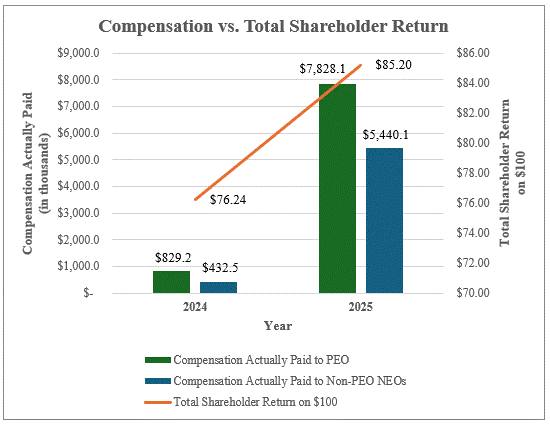
33
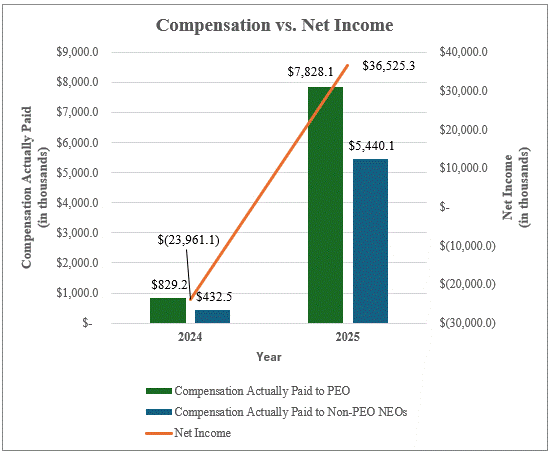
34
DIRECTOR COMPENSATION
Our non-employee directors receive annual grants of shares of unrestricted Common Stock equal to $175,000. In addition, the Audit Committee chair receives an additional $35,000 worth of shares of unrestricted Common Stock annually. We also reimburse our directors for reasonable travel expenses incurred in connection with attending meetings of our board of directors and any committee of our board of directors on which they serve, as well as other corporate events at which our directors’ attendance is requested or required. Directors do not receive any additional compensation.
The board of directors, in its discretion, may revise or replace the compensation policies described above.
Director Compensation Table
The following table sets forth information regarding compensation earned by or paid to our non-employee directors for the fiscal year ended December 31, 2025.
The compensation of Jay Jackson and Sean McNealy as named executive officers is set forth above under “Executive Compensation—Executive Compensation Table.”
| Name | Fees Earned or Paid in Cash ($) | Stock Awards ($)(1)(2) | Total ($) | |||||||||||||||||
| Adam Gusky | — | 175,000 | 175,000 | |||||||||||||||||
| Karla Radka | — | 175,000 | 175,000 | |||||||||||||||||
| Cornelis Michiel van Katwijk | — | 175,000 | 175,000 | |||||||||||||||||
| Thomas W. Corbett, Jr. | — | 175,000 | 175,000 | |||||||||||||||||
| Mary Beth Schulte | — | 210,000 | 210,000 | |||||||||||||||||
(1)Reflects the aggregate grant date fair value of awards computed in accordance with ASC 718.
(2)Stock awards were granted on March 12, 2026 for compensation partially earned for the fiscal year ended December 31, 2025, subject to the approval of the 2026 LTIP set forth as Proposal Three.
35
CERTAIN RELATIONSHIPS AND RELATED PARTY TRANSACTIONS
Sponsor PIK Note
Abacus Global Management, Inc. was formerly known as Abacus Life, Inc. and East Resources Acquisition Company (“ERES”). The Company was initially organized as ERES, a blank check company incorporated in Delaware on May 22, 2020. On June 30, 2023, we completed a business combination pursuant to which Longevity Market Assets, LLC, a Delaware limited liability company (“LMA”), and Abacus Settlements LLC, a Delaware limited liability company (“Abacus Settlements”) became wholly owned subsidiaries of the Company and the Company came to be constituted in its present form (the “Business Combination”).
On the closing date of the Business Combination, East Sponsor, LLC, a Delaware limited liability company (“ERES Sponsor”), made an unsecured loan to the Company in the aggregate amount of $10,471,648 (the “Sponsor PIK Note”). The Sponsor PIK Note matures on June 30, 2028 (the “Maturity Date”) and may be prepaid at any time in accordance with its terms without any premium or penalty. As of December 31, 2025 and March 31, 2026 there was $14,114,199 and $14,541,873 outstanding on the Sponsor PIK Note, respectively.
On July 5, 2023, in connection with an asset purchase agreement to acquire certain insurance policies from Abacus Investment SPV, LLC, Abacus amended and restated the Sponsor PIK Note (the “Amended Sponsor PIK Note”), pursuant to which, among other things, ERES Sponsor transferred its rights and obligations under the Sponsor PIK Note to East Asset Management, LLC, a Delaware limited liability company (“EAM”), the managing member of the ERES Sponsor. The Amended Sponsor PIK Note accrues interest daily at a rate of 12.0% per annum compounding semi-annually until the earlier to occur of the Maturity Date and the date on which it is repaid. Accrued and unpaid interest is payable in arrears on March 31, June 30, September 30 and December 31 of each year, beginning on September 30, 2023. Upon the occurrence of a Change of Control Event (as defined in the Amended Sponsor PIK Note), EAM will have the option to require the Company to redeem the Amended Sponsor PIK Note.
Carlisle Acquisition
On December 2, 2024, the Company completed the acquisition of Carlisle Management Company S.C.A., a corporate partnership limited by shares established under the laws of Luxembourg (“CMC”), Carlisle Investment Group S.A.R.L., a private limited liability company incorporated under the laws of Luxembourg (“CIG,” and together with CMC, “Carlisle”), a Luxembourg-based investment manager in the life settlement space (the “Carlisle Acquisition”). Carlisle is registered as an authorized alternative investment fund manager by Luxembourg’s Commission de Surveillance du Secteur Financier. Carlisle manages three funds and eight sub-funds. The funds and sub-funds managed by Carlisle are collectively referred to as the “Carlisle Funds”. Following the Carlisle Acquisition, business transactions, including sales and purchases of life insurance policies, with the funds managed by Carlisle are considered related party activity. Related party transactions and balances as of and for the year ended December 31, 2025 with the Carlisle Funds are as follows:
Fund / Sub-fund | Management / Performance Fees | Servicing Fees | Policy Sale Gains | Management / Performance Fee Receivable | Servicing Fee Receivable | Policy Purchases with different risk profiles | ||||||||||||||
Luxembourg Life Fund FCP SIF | ||||||||||||||||||||
| Long Term Growth Fund (in liquidation) | $ | 1,457,872 | $ | 39,832 | $ | — | $ | 301,146 | $ | 5,508 | $ | 3,000,000 | ||||||||
| Long Term Growth Funds 2021 | 11,226,663 | 348,820 | — | 2,699,718 | 67,308 | — | ||||||||||||||
36
Fund / Sub-fund | Management / Performance Fees | Servicing Fees | Policy Sale Gains | Management / Performance Fee Receivable | Servicing Fee Receivable | Policy Purchases with different risk profiles | ||||||||||||||
Absolute Return Fund I | 3,714,260 | 273,573 | — | 13,092,063 | 40,944 | 8,928,125 | ||||||||||||||
Long Term Growth Fund SICAV RAIF | ||||||||||||||||||||
| Compartment A | — | — | — | — | — | — | ||||||||||||||
| Air Life Fund II - Lux (in liquidation) | — | — | — | — | — | — | ||||||||||||||
Luxembourg Life Fund II FCP RAIF | ||||||||||||||||||||
Absolute Return Fund II | 3,473,307 | 415,484 | — | 1,972,873 | 91,014 | — | ||||||||||||||
Absolute Return Fund III | 5,724,823 | 268,073 | — | 2,513,740 | 63,339 | — | ||||||||||||||
Absolute Return Fund IV | 691,143 | 364,569 | 1,808,506 | 268,606 | 73,247 | 3,728,750 | ||||||||||||||
Total | $ | 26,288,068 | $ | 1,710,351 | $ | 1,808,506 | $ | 20,848,146 | $ | 341,360 | $ | 15,656,875 | ||||||||
In connection with the Carlisle Acquisition, the Company assumed a $2,000,000 payable to Pillo related to buyout of a CMC shareholder on December 2, 2024. This payable was fully repaid during 2025.
In addition, the Company entered into an Escrow Agreement with the sellers of the Carlisle business, including Pillo, which may be deemed to beneficially own approximately 6% of our Common Stock (which it received as partial consideration for the Carlisle Acquisition). Jose Esteban Casares Garcia, the sole member and sole manager of Pillo, is the chief executive officer of Carlisle Management Company S.A.R.L., a subsidiary of the Company. The Escrow Agreement requires a portion of the Common Stock and 9.875% fixed rate notes due 2028 received by Pillo and the other sellers in the Carlisle Acquisition, equal to 10% of the Base Purchase Price (as defined therein), to be placed in escrow until June 4, 2026 to fund payments for the purchase price adjustment and certain post-closing indemnification obligations.
In addition, such sellers, including Pillo, entered into an Equity Registration Rights Agreement and a Notes Registration Rights Agreement with the Company. The registration rights agreements provide certain registration rights in connection with the Common Stock and 9.875% fixed rate notes due 2028 received by Pillo and the other sellers in the Carlisle Acquisition. The registration rights agreements provide that the Company will file a shelf registration statement to permit the resale of the applicable securities from time to time, provide for certain demand and piggyback registration rights and provide that the Company will pay certain expenses with respect to such registration and indemnify the sellers against certain liabilities. In addition, such sellers, including Pillo, have executed a Share Lockup and Standstill Agreement providing that each seller will not (subject to certain customary exceptions) transfer such seller’s shares through July 3, 2025, and that each seller will not transfer more than 15% of the shares held on the closing date of the Carlisle Acquisition within any 30-day period. In addition, each such seller agreed, for 12 months following the closing date of the Carlisle Acquisition, not to initiate or participate in any acquisition of the Company’s securities that would result in (i) such seller and its affiliates and associates beneficially owning 10% or more of the Company’s voting securities or (ii) any group beneficially owning 20% or more of the Company’s voting securities.
On August 18, 2025, the Company issued 253,688 common shares with a fair value of $1,610,918 and bonds with an aggregate principal $2,002,400 to the Carlisle sellers as additional consideration ("Additional Consideration") disclosed in Form 424B3 Prospectus filed with the SEC on December 12, 2025 ("424B3"). The following parties listed on page 31 of the 424B3 are considered related parties: Pillo Portsmouth Holding Company, CMC Vehicle LLC (Jose Esteban Casares Garcia beneficially owns 52.94% of this entity), Victor Johannes Maarten Heggelman (CMC's Chief Financial Officer), Timmo Henk Mol (CMC's Chief Operating
37
Officer), Christopher Shawn Winters (Company's employee), Didier Morin (CMC's Chief Risk and Compliance Officer). Below please find "Additional Consideration" issued to related parties during 2025 that was in excess of $120,000:
Related Party | Common Share Value | Bond Value | Total | ||||||||
| Pillo Portsmouth Holding Company | $ | 851,618 | $ | — | $ | 851,618 | |||||
| CMC Vehicle LLC (Jose Esteban Casares Garcia beneficially owns 52.94% of this entity) | 185,680 | 230,800 | 416,480 | ||||||||
| Timmo Henk Mol (CMC's Chief Operating Officer) | 78,454 | 97,525 | 175,979 | ||||||||
Total | $ | 1,115,752 | $ | 328,325 | $ | 1,444,077 | |||||
LP Funds
During 2025, the Company established Abacus Enhanced Income Fixed LP, Abacus Enhanced Income Plus LP, Abacus Premiere Income Fixed LP, and Abacus Premiere Income Plus LP (collectively the “LP Funds”) and respective wholly owned general partner entities for the purpose of managing the LP Funds and servicing the policies invested by the LP Funds. Business transactions with these funds are considered related party activity.
Business transactions, including the sale and purchase of life insurance policies, with the LP funds managed by the Company are considered related party activity. Related party transactions and balances as of and for the year ended December 31, 2025 with the LP Funds are as follows:
| Fund / Sub-fund | Management Fees | Servicing Fees | Policy Sale Gains | Management / Performance Fee Receivable | Servicing Fee Receivable | Policy Purchases with different risk profiles | ||||||||||||||
| Abacus Enhanced Income Fixed LP | $ | 35,675 | $ | 12,533 | $ | 814,243 | $ | 17,644 | $ | 6,640 | $ | — | ||||||||
| Abacus Enhanced Income Plus LP | 9,227 | 5,395 | 854,066 | — | — | — | ||||||||||||||
| Abacus Premiere Income Fixed LP | 551,920 | 135,622 | 19,791,917 | 238,073 | 56,440 | 1,052,386 | ||||||||||||||
| Abacus Premiere Income Plus LP | 586,367 | 108,066 | 8,084,448 | 314,139 | 56,606 | 7,549,899 | ||||||||||||||
| Total | $ | 1,183,189 | $ | 261,616 | $ | 29,544,674 | $ | 569,856 | $ | 119,686 | $ | 8,602,285 | ||||||||
Securitized Entity
During October 2025, the Company established a securitization entity, 2025 LMA LLC (the “Securitized Entity”). The Securitized Entity was created to provide investors with a pool of life insurance policies to serve as static collateral. The investor’s investment in a promissory note issued by the Securitized Entity is secured by the static collateral pool and available cash. The Company, through its LMA subsidiary, services the static collateral pool, including through the sale and acquisition of life insurance policies.
Business transactions with these funds and business transactions with the Securitized Entity are considered related party activity. The Company concluded that it was not the primary beneficiary in the Securitized Entity due to lack authority to establish policies or make significant decision impacting the Securitization Fund, pursuant to accounting rules. Rather, the Company it is acting as the servicer for the securitized static collateral pool under the direct supervision of an independent manager. As a result, life insurance policy sales and fee revenue earned by the Company from the Securitized Entity is presented as related party servicing revenue in the Company’s consolidated financial statements.
Business transactions with the Securitized Entity serviced by the Company are considered related party activity. Related party transactions and balances as of and for the year ended December 31, 2025 with the Securitized Entity are as follows:
38
| Fund / Sub-fund | Management Fees | Servicing Fees | Policy Sale Gains | Management / Performance Fee Receivable | Servicing Fee Receivable | Policy Purchases with different risk profiles | ||||||||||||||
| 2025 LMA LLC | $ | — | $ | 103,553 | $ | 6,091,864 | $ | — | $ | 39,971 | $ | — | ||||||||
| Total | $ | — | $ | 103,553 | $ | 6,091,864 | $ | — | $ | 39,971 | $ | — | ||||||||
NIB Acquisition
On April 24, 2025, the Company completed the acquisition of National Insurance Brokerage, LLC ("NIB"), a Delaware limited liability company. NIB was owned by Jay Jackson, who held a 25% beneficial interest, and KMG Group Holdings, LLC ("KMG"), who held a 75% beneficial interest. KMG is equally owned by Matthew Ganovsky, K. Scott Kirby, and Sean McNealy. The Company paid $3,000,000 to acquire 100% of the interest in NIB.
Other Items
As of December 31, 2025, the Company had $1,773,440 in other receivables. This other receivable amount represents transaction costs incurred by the Company related to the formation of an investment fund being registered under the Investment Company Act of 1940 that will be reimbursed upon regulatory approval and effectiveness of the investment fund and subsequent sale of shares in the investment fund.
Relationships and Transactions with Affiliated Parties
David Jackson, who is the son of Jay Jackson, is employed by the Company as the Managing Director of Investor Relations and received compensation of $273,878 consisting of $244,231 for services rendered in 2025 and $29,647 for Company paid benefits.
Nolan McNealy, who is the son of Sean McNealy, is employed by a subsidiary of the Company as a Capital Markets Analyst and received compensation of $121,296, consisting of $116,000 for services rendered in 2025, $4,640 in matching contributions made by the Company to his 401(k) Plan account, and $656 for Company paid benefits.
Procedures with Respect to Review and Approval of Related Person Transactions
The board of directors of the Company recognizes the fact that transactions with related persons present a heightened risk of conflicts of interests (or the perception thereof). The board of directors has adopted a written policy on transactions with related persons that is in conformity with the requirements of the NYSE. Under the policy, the Company’s legal team is primarily responsible for maintaining processes and procedures to obtain information regarding related persons with respect to potential related person transactions and then determining, based on the facts and circumstances, whether such potential related person transactions do, in fact, constitute related person transactions requiring compliance with the policy. If the legal team determines that a transaction or relationship is a related person transaction requiring compliance with the policy, the Company’s general counsel presents to the audit committee all relevant facts and circumstances relating to the related person transaction. The audit committee reviews the relevant facts and circumstances of each related person transaction, including if the transaction is on terms comparable to those that could be obtained in arm’s length dealings with an unrelated third party and the extent of the related person’s interest in the transaction, taking into account the conflicts of interest and corporate opportunity provisions of the Company’s code of business conduct and ethics, and either approves or disapproves the related person transaction. If advance audit committee approval of a related person transaction requiring the audit committee’s approval is not feasible, then
39
the transaction may be preliminarily entered into by management upon prior approval of the transaction by the chair of the audit committee, subject to ratification of the transaction by the audit committee at the audit committee’s next regularly scheduled meeting; provided, that if ratification is not forthcoming, management will make all reasonable efforts to cancel or annul the transaction. If a transaction was not initially recognized as a related person transaction, then, upon such recognition, the transaction will be presented to the audit committee for ratification at the audit committee’s next regularly scheduled meeting; provided, that if ratification is not forthcoming, management will make all reasonable efforts to cancel or annul the transaction. The Company’s management will update the audit committee as to any material changes to any approved or ratified related person transaction and will provide a status report at least annually of all then current related person transactions. No director will be permitted to participate in approval of a related person transaction for which he or she is a related person.
40
EQUITY COMPENSATION PLAN INFORMATION
The following table summarizes share and exercise price information about the Company’s equity compensation plans as of December 31, 2025.
Number of securities to be issued upon exercise of outstanding options, warrants and rights (#) | Weighted-average exercise price of outstanding options, warrants and rights ($) | Number of securities remaining available for future issuance under equity compensation plans (excluding securities reflected in column (a)) (#) | |||||||||||||||
Equity Compensation plans approved by security holders (1) | 230,175 (2) | 12.37 (3) | 26,783 (4) | ||||||||||||||
| Equity Compensation plans not approved by security holders | — | — | — | ||||||||||||||
Total | (2) | ||||||||||||||||
(1)Includes the Abacus Life, Inc. Amended and Restated 2024 Long-Term Equity Compensation Incentive Plan (the "2024 LTIP").
(2)Represents shares that may be issued under awards of options and restricted stock units. Assumes exercise of all outstanding options and the vesting of all shares subject to restricted stock units.
(3)The weighted average exercise price does not apply to restricted stock units.
(4)Includes shares available for future issuance under the 2024 LTIP.
41
PROPOSAL THREE: TO ADOPT THE 2026 LONG-TERM EQUITY INCENTIVE PLAN
In 2024, the Company adopted 2024 LTIP to provide for the issuance of 5,000,000 shares of Common Stock. Since the 2024 LTIP was adopted, all but 26,783 of the shares of Common Stock previously reserved for issuance under that plan have been issued. Because of the relatively small number of shares remaining available for issuance pursuant to the 2024 LTIP, the Board on April 17, 2026, adopted a resolution adopting a new plan, the 2026 LTIP, to replace the 2024 LTIP and add the remaining shares under the 2024 LTIP to the pool of shares of Common Stock that may be issued as equity awards under the 2026 LTIP. The Company is seeking stockholder approval of the 2026 LTIP. If approved, the 2026 LTIP will replace the 2024 LTIP. Key provisions of the 2026 LTIP include:
•Updating the Company's name to "Abacus Global Management, Inc.";
•Reserving 17,000,000 shares of Common Stock for issuance under the 2026 LTIP (of which 17,000,000 may be issued as incentive stock options);
•Providing for a limit for non-employee director stock awards of $250,000 per year; and
•Providing that the aggregate number of shares available for issuance under the 2026 LTIP will automatically increase on January 1 of each year for a period of three years beginning January 1, 2027 and ending (and including) January 1, 2029, in an amount equal to the lesser of (i) five percent (5%) of the total number of shares outstanding on the last day of the immediately preceding calendar year; or (ii) such smaller number of shares as may be determined the Board prior to such date. The foregoing evergreen provision does not increase the number of incentive stock options that can be issued under the 2026 LTIP.
If stockholders approve the 2026 LTIP, no further awards will be made under the 2024 LTIP and the remaining authorized but unissued shares under the 2024 LTIP will be added to the pool of shares available for issuance under the 2026 LTIP.
Increasing the number of shares issuable under the Plan would allow us to continue awarding equity incentives which are an important part of our employee compensation program. If the 2026 LTIP is approved by our stockholders, the total number of shares of Common Stock that will be reserved for issuance under the 2026 LTIP will be 17,000,000. If our stockholders do not approve the 2026 LTIP, we will continue to use the existing 2024 LTIP to make grants of awards until the shares reserved for issuance under that plan are all granted, following which we may be restricted in our ability to attract, motivate, and retain highly skilled employees, including members of our management team. One alternative to using this plan as a benefit for employees would be to use increased cash compensation as an employee attraction, motivation, and retention tool. We do not believe that such increased cash compensation would be practicable or advisable. Instead, we believe the combination of cash compensation and the opportunity to participate as an equity owner together provide a more effective benefit vehicle than cash alone for attracting, motivating, and retaining our employees and that employee equity ownership better aligns the interests of employees and our stockholders. If we found it necessary to increase cash compensation in lieu of providing the opportunity to participate in equity ownership, that expenditure could increase our operating expenses and reduce our cash flow from operations, which may adversely affect our business and operating results. We also believe that reduced equity compensation would diminish the alignment between our employees’ interests and those of our stockholders.
42
Summary of the 2026 LTIP
This section summarizes certain principal features of the 2026 LTIP. The summary is qualified in its entirety by reference to the complete text of the 2026 LTIP.
Purpose
The purpose of the 2026 LTIP is to provide a means through which Abacus and its affiliates may attract, retain and motivate persons who make (or are expected to make) important contributions by providing these individuals with equity ownership opportunities and/or equity-linked compensatory opportunities. Equity awards and equity-linked compensatory opportunities are intended to motivate high levels of performance and align the interests of directors, employees and consultants with those of stockholders by giving directors, employees and consultants the perspective of an owner with an equity or equity-linked stake in Abacus and provide a means of recognizing their contributions to our success. The board of directors believes that equity awards are necessary for Abacus to remain competitive in its industry and are essential to recruiting and retaining highly qualified employees.
Eligibility and Administration
Our employees, consultants and directors may be eligible to receive awards under the 2026 LTIP. As of January 31, 2026, Abacus has 320 employees, five non-employee directors and no other individual service providers who may be eligible to receive awards under the 2026 LTIP.
The 2026 LTIP provides that it will be administered by a committee of, and appointed by, the board of directors of Abacus that shall be composed of two or more independent directors, and which shall be subject to the limitations imposed under the 2026 LTIP, Section 16 of the Exchange Act, stock exchange rules and other applicable laws. The Compensation Committee of the board of directors will administer the 2026 LTIP. The board of directors may, at its discretion, exercise any authority of the Compensation Committee under this Plan.
The Compensation Committee will have the authority to take all actions and make all determinations under the 2026 LTIP, to construe the 2026 LTIP and award agreements and to prescribe rules and regulations relating to the administration of the 2026 LTIP as it deems necessary or advisable and to determine if a Corporate Change (as defined in the 2026 LTIP) has occurred and the treatment of awards with respect to such event. The Compensation Committee will also have the authority to determine which eligible directors, employees and consultants receive awards, grant awards and set the terms and conditions of all awards under the 2026 LTIP, including any vesting and vesting acceleration provisions, subject to the conditions and limitations in the 2026 LTIP. The Compensation Committee may establish and administer any performance goals in connection with any awards, determine the extent to which any performance goals and/or other terms and conditions of an award are attained or are not attained, and adjust any performance goals in connection with a corporate transaction or extraordinary event. The Compensation Committee may determine if substitute awards will be granted in connection with a corporate transaction.
Effective Date; Duration of Plan
The 2026 LTIP will become effective upon the date approved by the stockholders of the Company (the “Effective Date”), and no award will be granted under the 2026 LTIP prior to such date. No awards may be granted under the 2026 LTIP after ten years from the Effective Date. Prior to approval of the 2026 LTIP by the stockholders, awards may be granted under the 2024 LTIP. In the event that the stockholders of the Company
43
do not approve of the Plan, the 2024 LTIP will remain in effect. If stockholder approval is obtained, all awards granted under the 2024 LTIP will remain in place subject to the terms of the 2026 LTIP.
The 2026 LTIP shall remain in effect until all stock options granted under the 2026 LTIP have been exercised or expired, all restricted stock awards granted under the 2026 LTIP have fully vested or been entirely forfeited, and all performance awards, phantom stock awards and RSU Awards have been fully satisfied or expired.
Shares Available for Awards
Our stockholders are being asked to approve 17,000,000 shares to be available for issuance under the 2026 LTIP, all of which may be issued as incentive stock options. In addition, our stockholders are being asked to approve that the aggregate number of shares available for issuance (other than for incentive stock options) under the 2026 LTIP will automatically increase on January 1 of each year for a period of three years beginning January 1, 2027 and ending (and including) January 1, 2029, in an amount equal to the lesser of (i) five percent (5%) of the total number of shares outstanding on the last day of the immediately preceding calendar year; or (ii) such smaller number of shares as may be determined the Board prior to such date.
The aggregate fair market value compensation on the date of grant of an award made to a non-employee director during a calendar year shall be determined by the Compensation Committee and shall not exceed $250,000 per calendar year.
If an award under the 2026 LTIP (or under the prior plans) is forfeited, expires unexercised or is settled for cash, any shares subject to such award may, to the extent of such forfeiture, expiration or cash settlement, immediately be used again for new grants under the 2026 LTIP. Any shares that are the subject of awards under the 2026 LTIP (or under the prior plans) which are exchanged for awards that do not involve shares shall also again immediately become available to be issued pursuant to awards granted under the 2026 LTIP. If shares are withheld to satisfy tax obligations with respect to an incentive stock option, such shares shall not again be available for issuance under the 2026 LTIP. If shares are tendered in payment of an option price of an option or the exercise price of a stock appreciation right, such shares shall not be available for issuance under the 2026 LTIP.
Awards granted under the 2026 LTIP upon the assumption of, or in substitution for, awards authorized or outstanding under a qualifying equity plan maintained by an entity with which we enter into a merger or similar corporate transaction will not reduce the shares available for grant under the 2026 LTIP, nor shall such shares subject to substitute awards again be available for grant under the 2026 LTIP to the extent of any forfeiture, expiration, or cash settlement under an award.
Awards
The 2026 LTIP provides for the grant of stock options, stock appreciation rights (“SARs”), restricted stock awards, performance awards, phantom stock awards, restricted stock unit awards (“RSUs”) and stock awards. Certain awards under the 2026 LTIP may constitute or provide for payment of “nonqualified deferred compensation” under Section 409A of the Code (“Section 409A”), which may impose additional requirements on the terms and conditions of such awards. All awards under the 2026 LTIP will be evidenced by award agreements, which will detail the terms and conditions of awards, including any applicable vesting and payment terms and post-termination exercise limitations. Awards other than cash awards generally will be settled in shares of the Company’s Common Stock, but the applicable award agreement may provide for cash settlement of any award. A brief description of each award type follows.
44
Stock Options and SARs. Stock options provide for the purchase of shares of our Common Stock in the future at an exercise price set on the grant date. Incentive stock options, in contrast to non-qualified stock options, may provide tax deferral beyond exercise and favorable capital gains tax treatment to their holders if certain holding period and other requirements of the Code are satisfied. SARs entitle their holder, upon exercise, to receive from us an amount equal to the appreciation of the shares subject to the award between the grant date and the exercise date. Unless otherwise determined by the Compensation Committee, the exercise price of a stock option or SAR may not be less than 100% of the fair market value of the underlying share on the grant date (or110% in the case of incentive stock options granted to certain significant stockholders), except with respect to certain substitute awards granted in connection with a corporate transaction. Unless otherwise determined by the Compensation Committee, the term of a stock option or SAR may not be longer than ten years (or five years in the case of incentive stock options granted to certain significant stockholders).
Restricted Stock. Restricted stock is an award of non-transferable shares of our Common Stock that are subject to certain vesting conditions and other restrictions.
Performance Awards. A Performance Award under the 2026 LTIP is an award of rights subject to vesting and transferability restrictions generally based upon the attainment of performance goals as the Compensation Committee may determine, payment of which may be made in cash or shares of our Common Stock, as specified in the holder’s Performance Award agreement. The 2026 LTIP provides that a performance goal may be based on one or more business criteria that apply to the holder, one or more of our business units, or us as a whole.
Phantom Stock. Phantom Stock Awards under the 2026 LTIP are awards of rights to receive the value of shares of our Common Stock that are subject to certain vesting conditions. Following the end of the vesting period for a Phantom Stock Award (or at such other time as may be provided in a Phantom Stock Award agreement), the holder of a Phantom Stock Award will be entitled to receive payment of cash, our Common Stock, or a combination thereof as determined by the Compensation Committee, in an amount not exceeding the maximum value of the Phantom Stock Award, based on the then vested value of the award.
Restricted Stock Units. RSUs are contractual promises to deliver shares of our Common Stock in the future or an equivalent in cash and other consideration determined by the Compensation Committee, which may also remain forfeitable unless and until specified conditions are met and may be accompanied by the right to receive the equivalent value of dividends paid on shares of our Common Stock prior to the delivery of the underlying shares (i.e., dividend equivalent rights). The terms and conditions applicable to RSUs will be determined by the Compensation Committee, subject to the conditions and limitations contained in the 2026 LTIP.
Stock Awards. Stock awards are awards of fully vested shares of our Common Stock.
Dividend Equivalents. Dividend equivalents represent the right to receive the equivalent value of dividends paid on shares of our Common Stock and may be granted alone or in tandem with awards other than stock options or SARs. Dividend equivalents granted under the 2026 LTIP in tandem with an award will be subject to the same vesting conditions as applicable to such award, and no portion of such dividend equivalents will be paid prior to vesting. Dividend equivalents are credited as of the dividend record dates during the period between the date an award is granted and the date such award vests, is exercised, is distributed or expires, as determined by the Compensation Committee.
45
Certain Transactions
The Compensation Committee has broad discretion to act under the 2026 LTIP, as well as adjust the terms and conditions of existing and future awards, to prevent the dilution or enlargement of intended benefits and facilitate necessary or desirable changes in the event of certain transactions and events affecting our Common Stock. In the event of a Corporate Change, the Compensation Committee may, among other alternatives, accelerate the vesting of awards, provide for cancellation of such awards in exchange for an amount of cash per share equal to the per share value of the shares of Common Stock in the transaction (with respect to stock options and SARS, the excess, if any, of such per share value over the exercise or base price), provide for the surviving entity in the transaction to assume outstanding awards or have a new award of a similar nature substituted for such awards, make such adjustments to awards then outstanding as the Compensation Committee deems appropriate to reflect such transaction or require surrender of some or all of the outstanding awards in exchange for an amount of cash equal to the maximum value of such awards. A “Corporate Change” is generally defined as (i) the Company is not the surviving entity in any merger or consolidation or other reorganization; (ii) the Company sells, leases or exchanges all or substantially all of its assets to any other person (other than an entity that is directly or indirectly wholly owned by the Company); (iii) the Company is to be dissolved; (iv) any person or group acquires or gains ownership or control (including, power to vote) of more than 50 percent of the outstanding shares of the Company’s voting stock (based on voting power); (v) as a result of or in connection with a contested election of directors, the individuals who were directors of the Company before such election shall cease to constitute a majority of the board of directors; or (vi) the Company is party to any other corporate transaction. Notwithstanding the foregoing, any of the foregoing transactions or events must be a “change in control event” under Section 409A in order to constitute a Corporate Change.
In the event of any change in the outstanding shares of the Common Stock by reason of any stock dividend, split, spinoff, recapitalization, merger, consolidation, combination, extraordinary dividend, exchange of shares or other change affecting the outstanding shares as a class without the Company’s receipt of consideration, or other equity restructuring of the Company’s equity within the meaning of Financial Accounting Standards Board (FASB) Accounting Standards Codification (ASC) Topic 718, Stock Compensation, adjustments shall be made by the Compensation Committee to (i) the terms, class, the number of shares and/or the exercise price per share relating to any outstanding awards, and (ii) the number and class or shares that are available for issuance under the plan and other share limitations under the plan. In addition, the Compensation Committee can take any of the actions permitted upon a Corporate Change.
No Repricing
Except in connection with certain changes in our capital structure, stockholder approval will be required for any amendment that reduces the exercise price of any stock option or SAR, or cancels any stock option or SAR that has an exercise price that is greater than the then-current fair market value of Common Stock in exchange for cash, other awards or stock options or SARs with an exercise price per share that is less than the exercise price per share of the original stock options or SARs.
Transferability
An Incentive Stock Option is not transferable other than by will or the laws of descent and distribution, and may be exercised during the employee’s lifetime only by the employee or such employee’s guardian or legal representative. All other awards under the 2026 LTIP are not transferable other than by will or the laws of
46
descent and distribution, pursuant to a qualified domestic relations order, or with the consent of the Compensation Committee (as to certain family transfers, or otherwise).
Plan Amendment and Termination
The board of directors may amend or terminate the 2026 LTIP at any time; however, no amendment may impair the rights of a participant with respect to an outstanding award under the 2026 LTIP without the consent of the affected participant. Further, the board of directors may not, without the consent of the stockholders, amend the 2026 LTIP to increase the maximum aggregate number of shares that may be issued under the 2026 LTIP or change the class of individuals eligible to receive awards under the 2026 LTIP or amend or eliminate the restrictions on repricing of awards. No awards may be granted under the 2026 LTIP after its termination.
Material U.S. Federal Income Tax Consequences
The following is a general summary under current law of the principal U.S. federal income tax consequences related to awards under the 2026 LTIP. Deductions described below may be limited by section 162(m) of the Code (“Section 162(m)”). This summary deals with the general federal income tax principles that apply and is provided only for general information. Phantom Stock, and certain other awards that may be granted pursuant to the 2026 LTIP, could be subject to additional taxes unless they are designed to comply with certain restrictions set forth in Section 409A and guidance promulgated thereunder.
Some kinds of taxes, such as state, local and foreign income taxes and federal employment taxes, are not discussed. This summary is not intended as tax advice to participants, who should consult their own tax advisors.
Restricted Stock. The recipient of a Restricted Stock award generally will not realize taxable income at the time of grant, and we generally will not be entitled to a deduction at that time, assuming that the restrictions constitute a substantial risk of forfeiture for federal income tax purposes. When the risk of forfeiture with respect to the stock subject to the award lapses, the holder generally will realize ordinary income in an amount equal to the fair market value of the shares of our Common stock at such time less the amount paid for the stock (if any), and, subject to Section 162(m), we will be entitled to a corresponding deduction. All dividends and distributions (or the cash equivalent thereof) with respect to a Restricted Stock award paid to the holder before the risk of forfeiture lapses generally will also be compensation income to the holder when paid and, subject to Section 162(m) as discussed below, deductible as such by us. Notwithstanding the foregoing, the holder of a Restricted Stock award may elect under section 83(b) of the Code to be taxed at the time of grant of the Restricted Stock award based on the fair market value of the shares of our Common Stock on the date of the award less the amount paid for the stock (if any), in which case (a) subject to Section 162(m), we will be entitled to a deduction at the same time and in the same amount, (b) dividends paid to the recipient during the period the forfeiture restrictions apply will be taxable as dividends and will not be deductible by us and (c) there will be no further federal income tax consequences when the risk of forfeiture lapses. Such election must be made not later than 30 days after the grant of the Restricted Stock award, and is irrevocable.
Restricted Stock Unit Awards. The grant of a Restricted Stock Unit Award (“RSU Award”) under the 2026 LTIP generally will not result in the recognition of any U.S. federal taxable income by the recipient or a deduction for us at the time of grant. At the time an RSU Award is settled in cash or shares the recipient will generally recognize ordinary income and, subject to Section 162(m), we will be entitled to a corresponding deduction. Generally, the measure of the income and the deduction will be based on the cash value of a
47
settlement in cash or on the number of shares of Common Stock issued in settlement of the RSU Award multiplied by the value of our Common Stock at the time the RSU Award is settled for a settlement in shares.
Stock Awards. The recipient of a Stock Award generally will realize taxable ordinary income at the time of grant in an amount equal to the fair market value of the shares of our Common Stock on the date of the award, and, subject to Section 162(m), we will be entitled to a corresponding deduction.
Incentive Stock Options. Incentive Stock Options are subject to special federal income tax treatment. No federal income tax is imposed on the optionee upon the grant or the exercise of an Incentive Stock Option if the optionee does not dispose of the shares acquired pursuant to the exercise within the two-year period beginning on the date the option was granted or within the one-year period beginning on the date the option was exercised (collectively, the “holding period”).
(i.) In such event, we would not be entitled to any deduction for federal income tax purposes in connection with the grant or exercise of the option or the disposition of the shares so acquired. With respect to an Incentive Stock Option, the difference between the fair market value of the stock on the date of exercise and the exercise price must generally be included as an item of adjustment for purposes of the optionee’s alternative minimum taxable income for the year in which such exercise occurs. However, if the optionee exercises an Incentive Stock Option and disposes of the shares received in the same year and the amount realized is less than the fair market value of the shares on the date of exercise, then the amount included in alternative minimum taxable income will not exceed the amount realized over the adjusted basis of the shares.
(ii) Upon disposition of the shares received upon exercise of an Incentive Stock Option after the holding period, any appreciation of the shares above the exercise price should constitute long-term capital gain. If an optionee disposes of shares acquired pursuant to his or her exercise of an Incentive Stock Option prior to the end of the holding period, the optionee will be treated as having received, at the time of disposition, compensation taxable as ordinary income. In such event, and subject to Section 162(m), we may claim a deduction for compensation paid at the same time and in the same amount as compensation is treated as received by the optionee.
(iii) The amount treated as compensation is the excess of the fair market value of the shares at the time of exercise (or in the case of a sale in which a loss would be recognized, the amount realized on the sale if less) over the exercise price; any amount realized in excess of the fair market value of the shares at the time of exercise would be treated as short-term or long-term capital gain, depending on the holding period of the shares.
Non-statutory Stock Options and Stock Appreciation Rights. Generally, no federal income tax is imposed on the optionee upon the grant of a Non-statutory Stock Option or a SAR, and we are not entitled to a tax deduction by reason of such grant. Generally, upon the exercise of a Non-statutory Stock Option, the optionee will be treated as receiving compensation taxable as ordinary income in the year of exercise in an amount equal to the excess of the fair market value of the shares of stock at the time of exercise over the option price paid for such shares. In the case of the exercise of a SAR, the holder generally will be treated as receiving compensation taxable as ordinary income in the year of exercise in an amount equal to the cash received or the fair market value of the shares distributed to the optionee. Upon the exercise of a Non-statutory Stock Option or a SAR, and subject to Section 162(m), we may claim a deduction for compensation paid at the same time and in the same amount as compensation income is recognized by the optionee assuming any federal income tax reporting requirements are satisfied.
Performance Awards, Phantom Stock Awards and Stock Awards. An individual who has been granted a Performance Award, a Phantom Stock Award or a Stock Award generally will not realize taxable income at
48
the time of grant, and we will not be entitled to a deduction at that time. Whether such an award is paid in cash or shares of Common Stock, the individual generally will have taxable compensation and, subject to Section 162(m), we generally will have a corresponding deduction. The measure of such income and deduction will be based on the amount of any cash paid and the fair market value of any shares of our Common Stock either at the time the award is paid or at the time any restrictions on the shares subsequently lapse, depending on the nature, if any, of the restrictions imposed and whether the individual elects to be taxed without regard to any such restrictions.
Section 162(m). Generally, Section 162(m) precludes a public corporation from taking a deduction for annual compensation in excess of $1,000,000 paid to its covered employees (as defined in Section 162(m)).
Section 409A
Certain types of awards under the 2026 LTIP may constitute, or provide for, a deferral of compensation subject to Section 409A. Unless certain requirements set forth in Section 409A are complied with, holders of such awards may be taxed earlier than would otherwise be the case (e.g., at the time of vesting instead of the time of payment) and may be subject to an additional 20% penalty tax (and, potentially, certain interest, penalties and additional state taxes). To the extent applicable, the 2026 LTIP and awards granted under the 2026 LTIP are intended to be structured and interpreted in a manner intended to either comply with or be exempt from Section 409A and the Department of Treasury regulations and other interpretive guidance that may be issued under Section 409A. To the extent determined necessary or appropriate by the Compensation Committee, the 2026 LTIP and applicable award agreements may be amended to further comply with Section 409A or to exempt the applicable awards from Section 409A.
New Plan Benefits
Our Compensation Committee conditionally granted incentive compensation awards under the 2026 LTIP on March 12, 2026 to Mr. Jackson and Mr. McCauley, as described above in the Narrative to the Summary Compensation Table. The Compensation Committee also conditionally granted certain awards to certain executives of the Company. These awards will not be effective unless and until the shareholders approve the 2026 LTIP at the Company’s 2026 Annual Meeting of Stockholders.
| Number of Shares Subject to RSUs Granted | Dollar Value RSUs Granted (1) | |||||||||||||
Jay Jackson Chief Executive Officer | 3,188,199 | (2) | $6,000,000 | (3) | ||||||||||
William McCauley Chief Financial Officer | 1,594,060 | (4) | $3,000,000 | (5) | ||||||||||
Sean McNealy Co-Founder and President | — | $— | ||||||||||||
| Executive Officers as a group | 7,970,299 | (6) | $15,000,000 | (7) | ||||||||||
| Non-executive directors as a group | 90,100 | $910,000 | ||||||||||||
| Non-executive officer employees group | — | $— | ||||||||||||
(1)Reflects the aggregate grant date fair value of awards computed in accordance with ASC 718.
(2)Includes 2,000,000 shares awarded subject to performance-based restrictions based on certain stretch market capitalization or assets under management targets being met during 2026 and up to 1,188,119 stretch shares awarded subject to time and performance vesting.
49
(3)This amount assumes that RSUs granted vest achieve target (594,060 shares) performance over the performance period, should all shares at stretch performance vest, the dollar value of RSUs granted would be $32,200,000.
(4)Includes 1,000,000 shares awarded subject to performance-based restrictions based on certain stretch market capitalization or assets under management targets being met during 2026 and up to 594,060 stretch shares awarded subject to time and performance vesting.
(5)This amount assumes that RSUs granted vest achieve target (297,030 shares) performance over the performance period, should all shares at stretch performance vest, the dollar value of RSUs granted would be $16,100,000.
(6)Includes 5,000,000 shares awarded subject to performance-based restrictions based on certain stretch market capitalization or assets under management targets being met during 2026 and up to 2,970,299 stretch shares awarded subject to time and performance vesting.
(7)This amount assumes that RSUs granted vest achieve target (1,485,150 shares) performance over the performance period, should all shares at stretch performance vest, the dollar value of RSUs granted would be $80,500,000.
The 2026 LTIP is attached to this Proxy Statement as Appendix A.
Vote Required
The affirmative “FOR” vote of a majority of the votes cast by holders of shares of our Common Stock present in person or by proxy during the Annual Meeting and entitled to vote thereon will be required to approve the 2026 LTIP. Abstentions will be counted as present and entitled to vote on the proposal and will therefore have the effect of a vote “AGAINST” the approval of the 2026 LTIP. Broker non-votes will not be entitled to vote on Proposal Three and will therefore have no effect on Proposal Three.
OUR BOARD OF DIRECTORS RECOMMENDS A VOTE “FOR” THE ADOPTION OF THE 2026 LTIP, IN THE FORM ATTACHED HERETO AS APPENDIX A, WHICH HAS BEEN APPROVED AND ADOPTED BY THE BOARD OF DIRECTORS
50
PROPOSAL FOUR: ADVISORY VOTE ON EXECUTIVE COMPENSATION
Pursuant to Section 14A of the Exchange Act, and the Dodd-Frank Wall Street Reform and Consumer Protection Act of 2010 (the “Dodd-Frank Act”), we are providing to our stockholders an opportunity to cast a non-binding, advisory vote on the compensation of our named executive officers as disclosed in this Proxy Statement in accordance with the SEC’s compensation disclosure rules. This is commonly known as a “Say-on-Pay” vote.
Our executive compensation programs are designed to: (i) motivate, retain and recruit the executive talent needed to drive stockholder value and help us grow our business; (ii) reward the achievement of short-term and long-term performance goals; (iii) establish an appropriate relationship between executive pay and short-term and long-term performance; (iv) balance salary and incentive compensation to encourage performance; and (v) align the interests of our named executive officers with those of our common stock stockholders. See “Executive Compensation” for additional details about our executive compensation programs, including information about the 2026 compensation of our named executive officers.
We are asking our common stock stockholders to indicate their support for the compensation of our named executive officers as disclosed in this Proxy Statement. This Say-on-Pay vote gives our stockholders the opportunity to express their views on our executive compensation. This vote is not intended to address any specific item of compensation, but rather the overall compensation of our named executive officers and the compensation policies and practices described in this Proxy Statement. Accordingly, we will ask our common stock stockholders to vote “FOR” the following resolution at the Annual Meeting:
“RESOLVED, that the common stock stockholders of Abacus Global Management, Inc. approve, on an advisory basis, the compensation of the Company’s named executive officers as disclosed in the ”Executive Compensation“ section of the proxy statement for the 2026 Annual Meeting of stockholders pursuant to the SEC’s compensation disclosure rules, which disclosure includes the compensation tables and narrative discussion.”
The Say-on-Pay vote is advisory and, therefore, not binding on the Company, the Board or the Compensation Committee. The Board and the Compensation Committee value the opinions of our stockholders. To the extent there is a significant vote against the compensation of our named executive officers as disclosed in this Proxy Statement, we will consider our stockholders’ concerns and the Compensation Committee will evaluate whether any actions are necessary to address those concerns.
Vote Required
The affirmative “FOR” vote of a majority of the votes cast by holders of shares of our Common Stock present in person or by proxy during the Annual Meeting and entitled to vote thereon will be required to approve, on an advisory basis, the compensation of the Company’s named executive officers. Abstentions will be counted as present and entitled to vote on the proposal and will therefore have the effect of a vote “AGAINST” the approval of Proposal 4. Broker non-votes will not be entitled to vote on Proposal Four and will therefore have no effect on Proposal Four.
OUR BOARD OF DIRECTORS RECOMMENDS A VOTE “FOR” THE ADVISORY VOTE ON EXECUTIVE COMPENSATION
51
PROPOSAL FIVE ADVISORY VOTE ON FREQUENCY OF THE SAY-ON-PAY VOTE
Pursuant to Section 14A of the Exchange Act and the Dodd-Frank Act, we also are providing stockholders an opportunity to cast a separate non-binding, advisory vote indicating how frequently we should seek a Say-on-Pay vote on executive compensation. The vote provides stockholders with four voting choices regarding the frequency of a Say-on-Pay vote: (i) 1 year; (ii) 2 years; (iii) 3 years; or (iv) abstain. Our stockholders will not be voting to approve or disapprove the recommendations of the Board.
After careful consideration, the Board has determined that an advisory vote on executive compensation that occurs every 3 years is the most appropriate alternative for the Company and, therefore, recommends that you vote in favor of a three-year interval for the advisory vote on executive compensation.
In formulating its recommendation, the Board considered the importance of receiving regular input from stockholders on important issues, such as our compensation policies, practices and procedures. The Board recognizes, however, that well-structured executive compensation programs should include plans designed to drive the creation of stockholder value over the long term and do not simply focus on short-term gains. Accordingly, the Board believes a triennial vote would be the most appropriate option for the Company because it would provide the Company with time to assess the effectiveness of our executive compensation programs over the long term and to thoughtfully respond to stockholder concerns and evaluate whether any actions are necessary to address those concerns.
The vote on the preferred frequency of the say-on-pay vote is advisory and, therefore, not binding on the Company, the Board or the Compensation Committee. Although the vote is non-binding, the Board and the Compensation Committee will consider the results of the vote, as well as other communications from our stockholders, in determining the frequency of future say-on-pay votes. The Board may decide that it is in the best interests of our stockholders and the Company to hold an advisory vote on executive compensation more or less frequently than the non-binding option recommended by our stockholders.
Unless otherwise instructed, the Proxy Holders will vote proxies held by them in favor of a “3 YEAR” frequency on the say-on-pay vote as described above.
Vote Required
The option receiving the greatest number of votes cast on such proposal at the Annual Meeting (every 1 year, 2 years, or 3 years) will be considered the frequency recommended by the stockholders. Abstentions will not be counted as votes cast on such proposal, and thus will have no effect thereon. Broker non-votes will not be entitled to vote on Proposal Five and will therefore have no effect on Proposal Five.
OUR BOARD OF DIRECTORS RECOMMENDS A VOTE FOR THE “3 YEAR” OPTION AS THE PREFERRED FREQUENCY ON THE SAY-ON-PAY VOTE
52
OTHER MATTERS
Our board of directors knows of no other matters that will be presented for consideration at the Annual Meeting. If any other matters are properly brought before the Annual Meeting, it is the intention of the persons named in the accompanying proxy to vote on such matters in accordance with his best judgment.
April 21, 2026
We have filed our Annual Report on Form 10-K for the fiscal year ended December 31, 2025 with the SEC. It is available free of charge at the SEC’s web site at www.sec.gov. Stockholders can also access this Proxy Statement and our Annual Report on Form 10-K at https://ir.abacusgm.com/sec-filings/all-sec-filings. A copy of our Annual Report on Form 10-K for the fiscal year ended December 31, 2025 is also available without charge by writing to Corporate Secretary, Abacus Global Management, Inc., 2101 Park Center Drive, Suite 200, Orlando, Florida 32835, or by telephone request to (800) 561-4148.
53
APPENDIX A
ABACUS GLOBAL MANAGEMENT, INC.
2026 LONG-TERM EQUITY
INCENTIVE PLAN
1.PURPOSE
The purpose of the ABACUS GLOBAL MANAGEMENT, INC. 2026 LONG-TERM EQUITY INCENTIVE PLAN (the “Plan”) is to provide a means through which Abacus Global Management, Inc., a Delaware corporation (“Company”), and its Affiliates may attract able individuals to enter the employ or to serve as Directors or Consultants of the Company and any of its Affiliates and to provide a means whereby those individuals upon whom the responsibilities of the successful administration and management of the Company and its Affiliates rest, and whose present and potential contributions to the Company and its Affiliates are of importance, can acquire and maintain ownership of the Company’s Common Stock, thereby strengthening their concern for the welfare of the Company and its Affiliates. A further purpose of the Plan is to provide such individuals with additional incentive and reward opportunities designed to enhance the profitable growth of the Company and its Affiliates. Accordingly, the Plan provides for granting Incentive Stock Options, Options that do not constitute Incentive Stock Options, Restricted Stock Awards, Performance Awards, Stock Appreciation Rights, Phantom Stock Awards, Stock Awards, Restricted Stock Unit Awards, or any combination of the foregoing, as is best suited to the circumstances of the particular Employee, Consultant, or Director as provided herein.
1.DEFINITIONS
The following definitions shall be applicable throughout the Plan unless specifically modified by any provision of the Plan:
a.“Affiliate” means any Entity which, directly or indirectly, controls, is controlled by, or is under common control with, the Company. For purposes of the preceding sentence, “control” (including, with correlative meanings, the terms “controlled by” and “under common control with”), as used with respect to any Entity, shall mean the possession, directly or indirectly, of the power (i) to vote more than 50% of the securities having ordinary voting power for the election of directors of the controlled Entity, or (ii) to direct or cause the direction of the management and policies of the controlled Entity, whether through the ownership of voting securities or by contract or otherwise.
b.“Award” means any Option, Stock Appreciation Right, Restricted Stock Award, Performance Award, Phantom Stock Award, Stock Award or Restricted Stock Unit Award granted under the Plan.
c.“Award Agreement” means a written agreement between the Company and a Participant evidencing an Award and its terms. Each Award Agreement shall designate (i) the type of Award being issued; (ii) the vesting conditions or forfeiture provisions applicable to the Award, including any applicable Performance Goals or provisions constituting a Substantial Risk of Forfeiture; (iii) transferability restrictions; (iv) any applicable rules regarding delivery of Shares issued by the Company under the Award; (v) subject to Section V(g) below, and to the extent applicable, provisions regarding payments by the Company of dividends or Dividend
54
Equivalents; and (vi) any additional matters as the Committee may determine to be appropriate. The terms and provisions of each Award Agreement need not be identical. Except as otherwise provided in the Plan, subject to the consent of the Participant, the Committee may, in its sole discretion, amend an outstanding Award Agreement from time to time in any manner that is not inconsistent with the provisions of the Plan.
d.“Board” means the Board of Directors of the Company.
e.“Change of Control Value” means the amount determined in clause (i), (ii) or (iii), whichever is applicable, as follows:
i.the per Share price offered to stockholders of the Company in a Corporate Change which is a merger, consolidation, sale of assets or dissolution transaction;
ii.the price per Share offered to stockholders of the Company in any tender offer or exchange offer whereby a Corporate Change occurs; or
iii.if a Corporate Change occurs other than pursuant to a tender or exchange offer of Shares and an Award will be cancelled by or surrendered to the Committee as a result of such transaction, the Fair Market Value per share of the Shares underlying such Award, as determined by the Committee as of the date determined by the Committee to be the date of cancellation and surrender of such Award.
In the event that the consideration offered to stockholders of the Company in any transaction which results in a Corporate Change consists of anything other than cash, the Committee shall determine the fair cash equivalent of the portion of the consideration offered which is other than cash.
a.“Code” means the Internal Revenue Code of 1986, as amended. Reference in the Plan to any section of the Code shall be deemed to include any amendments or successor provisions to such section and any regulations issued by the Department of Treasury under such section.
b.“Committee” means a committee of the Board that is selected by the Board as provided in Section IV(a).
c.“Common Stock” means the common stock, par value $.0001 per share, of the Company, or any security into which such Common Stock may be changed by reason of any transaction or event of the type described in Section XIII.
d.“Company” means Abacus Global Management, Inc., a Delaware corporation. The Company was formerly known as Abacus Life, Inc.
e.“Consultant” means consultant, advisor or other person or Entity that is not an Employee, in each case, that can be granted an Award that is eligible to be registered on a Form S-8 Registration Statement.
f.“Corporate Change” means a transaction or event in which:
i.the Company is not the surviving entity in any merger or consolidation or other reorganization (or survives only as a subsidiary of an entity other than an entity that
55
was directly or indirectly wholly owned by the Company immediately prior to such merger, consolidation or other reorganization);
ii.the Company sells, leases or exchanges all or substantially all of its assets to any other person (other than an entity that is directly or indirectly wholly owned by the Company);
iii.the Company is to be dissolved;
iv.any person, including a “group” as contemplated by Section 13(d)(3) of the 1934 Act, acquires or gains ownership or control (including, power to vote) of more than 50 percent of the outstanding shares of the Company’s voting stock (based on voting power);
v.as a result of or in connection with a contested election of Directors, the individuals who were Directors of the Company before such election shall cease to constitute a majority of the Board; or
vi.the Company is party to any other corporate transaction (as defined under section 424(a) of the Code and applicable Department of Treasury regulations) that is not described in clauses (i), (ii), (iii), (iv) or (v) above.
Notwithstanding the foregoing, any of the foregoing transactions or events must constitute a 409A Change in Control in order to constitute a Corporate Change under this Plan.
a.“Director” means an individual elected or appointed to the Board by the stockholders of the Company or by the Board under applicable corporate law.
b.“Disability” means as determined by the Committee in its discretion,
i.in the case of an Award (other than an Incentive Stock Option) that is exempt from the application of the requirements of Section 409A, a physical or mental condition of the Participant that would entitle the Participant to payment of disability income payments under the Company’s group long-term disability insurance policy or plan for employees as then in effect, or in the event that the Participant is a Director or is not covered (for whatever reason) under the Company’s group long-term disability insurance policy or plan for employees or in the event the Company does not maintain such a group long-term disability insurance policy, and in the case of an Incentive Stock Option, “Disability” means a permanent and total disability as defined in section 22(e)(3) of the Code; and
ii.in the case of an Award that is not exempt from the application of the requirements of Section 409A, (1) the Participant is unable to engage in any substantial gainful activity by reason of any medically determinable physical or mental impairment that can be expected to result in death or can be expected to last for a continuous period of not less than 12 months, or (2) the Participant is, by reason of any medically determinable physical or mental impairment that can be expected to result in death or can be expected to last for a continuous period of not less than 12 months, receiving income replacement benefits for a period of not less than three months under an accident and health plan covering employees of the Company.
56
A determination of Disability may be made by a physician selected or approved by the Committee and, in this respect, the Participant shall submit to an examination by such physician upon request by the Committee.
a.“Dividend Equivalent” means a payment equivalent in amount to dividends paid to the Company’s stockholders.
b.“Employee” means any individual in an employment relationship with the Company or any Affiliate. Directors who are Employees shall be considered Employees under the Plan.
c.“Entity” means a corporation, limited liability company, partnership, limited partnership or any other type of legal entity or organization.
d.“Fair Market Value” on any date means the market price of Common Stock:
i.if the Common Stock is listed on one or more established stock exchanges or national market systems, including without limitation the New York Stock Exchange and NASDAQ, its Fair Market Value shall be the closing sales price for such stock (or the closing bid, if no sales were reported) as quoted on the principal exchange or system on which the Common Stock is listed on the date of determination (or, if no closing sales price or closing bid was reported on that date on the last trading date such closing sales price or closing bid was reported), as reported by The Wall Street Journal (including through www.wsj.com) or such other source as the Committee deems reliable;
ii.if the Common Stock is regularly quoted on an automated quotation system (including the OTC Bulletin Board) or by a recognized securities dealer, its Fair Market Value shall be the closing sales price for such stock as quoted on such system or by such securities dealer on the date of determination, but if selling prices are not reported, the Fair Market Value of a share of Common Stock shall be the mean between the high bid and low asked prices for the Common Stock on the date of determination (or, if no such prices were reported on that date, on the last date such prices were reported), as reported by The Wall Street Journal (including through www.wsj.com) or such other source as the Committee deems reliable; or (iii) in the absence of an established market for the Common Stock of the type described in (i) and (ii), above, the Fair Market Value thereof shall be determined by the Committee in its discretion.
With respect to Options and SARs, the Committee shall determine Fair Market Value in a manner that satisfies the applicable requirements of Code Section 409A. The Committee’s determination of Fair Market Value shall be final, binding, and conclusive on all individuals.
a.“Forfeiture Restrictions” has the meaning assigned to such term in Section VIII(a).
b.“Holder” means the holder of an Award, which includes the Participant, a beneficiary, or the Immediate Family, as applicable.
c.“Immediate Family” means, with respect to a Participant, such Participant’s spouse, children, or grandchildren (including adopted children, stepchildren, and grandchildren).
57
d.“Incentive Stock Option” means an incentive stock option within the meaning of section 422 of the Code.
e.“Mature Shares” means Shares which have been held by the Participant and with respect to which any applicable forfeiture restrictions have lapsed, in each case, for at least six months.
f.“Option” means an Award (other than a SAR) granted under Section VII and includes both Incentive Stock Options to purchase Common Stock and Options that do not constitute Incentive Stock Options to purchase Common Stock.
g.“Participant” means an Employee, Consultant, or Director who has been granted an Award.
h.“Performance Award” means an Award granted under Section IX.
i.“Performance Goals” means the criteria the Committee selects for purposes of calculating vesting, exercisability, and payment under a Performance Award. The Performance Goals shall be designated by the Committee in its sole discretion and may be based on (i) one or more business criteria that apply to the Participant, (ii) one or more business units of the Company or an Affiliate, or (iii) the Company and Affiliates as a whole, and may reference to one or more performance metrics including without limitation: Common Stock price (including adjustments for dividends), funds from operations, adjusted funds from operations, earnings or adjusted earnings before or after interest, taxes, depletion, depreciation or amortization, earnings per share, earnings per share growth, total stockholder return, economic value added, cash return on capitalization, increased revenue, revenue ratios (per employee or per customer), net income (before or after taxes), market share, return on equity, return on assets, return on capital, return on capital compared to cost of capital, return on capital employed, return on invested capital, return on investment, return on sales, operating or profit margins, stockholder value, net cash flow, operating income, cash flow, cash flow from operations, cost reductions or cost savings, cost ratios (per employee or per customer), expense control, sales, proceeds from dispositions, project completion time, budget goals, net cash flow before financing activities, customer growth, total capitalization, debt to total capitalization ratio, credit quality or debt ratings, dividend payout, dividend growth, production volumes or safety results, or such other events or matters as the Committee determines appropriate in its sole discretion. Performance Goals may also be based on performance relative to a peer group or index of companies. Unless otherwise stated, such a Performance Goal need not be based upon an increase or positive result under a particular business criterion and could include, for example, maintaining the status quo or limiting economic losses (measured, in each case, by reference to specific business criteria). The Committee, in its discretion, may adjust or modify the calculation of Performance Goals for each performance period in order to prevent the dilution or enlargement of the rights of Participants under Awards (i) in the event of, or in anticipation of, any unusual or extraordinary corporate item, transaction, event, or development affecting the Company or any Affiliate; (ii) in the event of, or in connection with, any acquisition or divestiture of a portion of the Company’s or any Affiliate’s business or operations; or (iii) in recognition of, or in anticipation of, any other unusual or nonrecurring events affecting the Company or any Affiliate, or the financial statements of the Company or any Affiliate, or in response to, or in anticipation of,
58
changes in applicable laws, regulations, accounting principles, or business conditions affecting the Company or any Affiliate.
j.“Person” means an individual or Entity.
k.“Phantom Stock Award” means an Award granted under Section X.
l.“Plan” means the Abacus Global Management, Inc. 2026 Long-Term Equity Incentive Plan, as it may be amended, supplemented, or restated from time to time in accordance with its terms.
m.“Prior Plan” means either (i) the 2024 Plan or (ii) the Abacus Life, Inc. 2023 Long-Term Equity Compensation Incentive Plan prior to this amendment and restatement.
n.“Restricted Stock Award” means an Award granted under Section VIII.
o.“Restricted Stock Unit Award” or “RSU Award” means an Award granted under Section XII.
p.“Rule 16b-3” means SEC Rule 16b-3 promulgated under the 1934 Act, as such may be amended from time to time, and any successor rule, regulation or statute fulfilling the same or a similar function.
q.“Section 409A” means section 409A of the Code and other guidance promulgated by the Internal Revenue Service under Section 409A.
r.“Share” means a share of Common Stock.
s.“Stock Appreciation Right” or “SAR” means a stock appreciation right granted pursuant to Section VII.
t.“Stock Award” means an Award granted pursuant to Section XI.
u.“Substantial Risk of Forfeiture” has the meaning ascribed to that term in Section 409A.
v.“409A Change in Control” means a change in the ownership or effective control of the Company, or a change in the ownership of a substantial portion of the assets of the Company, within the meaning of Section 409A(a)(2)(A)(v) of the Code.
w.“1934 Act” means the Securities Exchange Act of 1934, as amended.
x.“2024 Plan” means the Abacus Life, Inc. Amended and Restated 2024 Long-Term Equity Compensation Incentive Plan.
2.EFFECTIVE DATE AND DURATION OF THE PLAN
The Plan shall become effective upon the date approved by the stockholders of the Company (the “Effective Date”), and no Award shall be granted under the Plan prior to such date. No Awards may be granted under the Plan after ten years from the Effective Date of the Plan. If the stockholders of the Company approve the Plan, no further Awards will be granted under the 2024 Plan and all Awards granted under the Prior Plans will remain in place subject to the terms of the applicable Prior Plan. The Plan shall remain in effect until all Options granted under the Plan have been exercised or expired, all Restricted Stock Awards granted under the
59
Plan have fully vested or been entirely forfeited, and all Performance Awards, Phantom Stock Awards and RSU Awards have been fully satisfied or expired.
1.ADMINISTRATION
a.Composition of Committee. The Plan shall be administered by a committee of, and appointed by, the Board that shall be comprised solely of two or more independent Directors (within the meaning of the term “Non-Employee Director” as defined in Rule 16b-3). Unless otherwise provided by the Board, the Committee shall be the Compensation Committee of the Board.
b.Powers. Subject to the terms and provisions of the Plan, the Committee, at any time, and from time to time, may grant Awards under the Plan to eligible individuals in such amounts and upon such terms as the Committee shall determine. Subject to the express provisions of the Plan, the Committee shall have authority, in its discretion, to determine which Employees, Consultants or Directors shall receive an Award, the time or times when such Award shall be made, the type of Award that shall be made, the number of Shares to be subject to each Option, SAR, Stock Award or Restricted Stock Award, and the number of Shares subject to or the value of each Performance Award, RSU Award or Phantom Stock Award. In making such determinations, the Committee shall take into account the nature of the services rendered by the respective Employees, Consultants, or Directors, their present and potential contribution to the Company’s success and such other factors as the Committee in its sole discretion shall deem relevant.
c.Additional Powers. The Committee shall have such additional powers as are delegated to it by the other provisions of the Plan. Subject to the express provisions of the Plan, this shall include the power to approve the terms of each Award Agreement, to construe the Plan and the respective Award Agreements executed hereunder, to prescribe rules and regulations relating to the administration of the Plan, to determine if a Corporate Change has occurred and the treatment of Awards with respect to such event and to determine the terms, conditions, restrictions and provisions of each Award Agreement, including such terms, conditions, restrictions and provisions as shall be requisite in the judgment of the Committee to cause designated Options to qualify as Incentive Stock Options, and to make all other determinations necessary or advisable for administering the Plan. The Committee may establish and administer any performance goals in connection with any Awards, determine the extent to which any performance goals and/or other terms and conditions of an Award are attained or are not attained, and adjust any performance goals in connection with a Corporate Change or other corporate transaction or extraordinary event. The Committee may grant substitute awards in connection with a corporate transaction pursuant to Section V(e) with terms and conditions as the Committee may prescribe. The Committee may specify in any Award Agreement the effect under the applicable Award of the occurrence of the death, Disability, retirement, or cessation of employment of the Participant with the Company and all Affiliates, the cessation of services rendered by the Participant to the Company and all Affiliates, or the occurrence of a Corporate Change. The Committee may, in its discretion and as of a date determined by the Committee, fully vest any Award, in whole or in part. The Committee may rely on the descriptions, representations, reports and estimates provided to it by the management of the Company or an Affiliate for determinations to be made pursuant to the Plan. The Committee may correct any
60
defect or supply any omission or reconcile any inconsistency in the Plan or in any Award Agreement in the manner and to the extent it shall deem expedient to carry it into effect. The determinations of the Committee on the matters referred to in this Section IV shall be final, binding, and conclusive on all individuals. The Board may, in its discretion, exercise any authority of the Committee under this Plan.
d.Delegation of Authority. The Committee in its sole discretion and on such terms and conditions as it may provide may delegate all or any part of its authority and powers under the Plan to one or more members of the Board and/or officers of the Company; provided, however, that the Committee may not delegate its authority or power with respect to (i) the selection for participation in this Plan of an officer of the Company or other person subject to Section 16 of the Exchange Act or decisions concerning the timing, pricing or amount of an Award to such an officer or Person; or (ii) any Awards to a Director.
2.SHARES SUBJECT TO THE PLAN; AWARD LIMITS; GRANT OF AWARDS
a.Number of Shares Available for Awards.
i.Subject to adjustment as provided in Section XIII, the aggregate number of Shares that may be issued under the Plan shall be equal to the sum of: (i) 17,000,000 Shares; plus (ii) the 2024 Plan’s outstanding and unissued Shares; plus (iii) Returning Shares (defined below). In addition, subject to any adjustments, such aggregate number of Shares will automatically increase on January 1 of each year (“Evergreen Date”) for a period of three years beginning January 1, 2027 and ending (and including) January 1, 2029, in an amount equal to the lesser of (i) five percent (5%) of the total number of Shares outstanding on the last day of the immediately preceding calendar year; or (ii) such smaller number of Shares (which may be zero) as may be determined by the Board prior to the Evergreen Date.
ii.The Shares that are available for issuance under the Plan may be issued in any form of Award authorized under the Plan. Any Shares that are the subject of Awards under the Plan or a Prior Plan which are forfeited or terminated, expire unexercised, are settled in cash in lieu of Shares or in a manner such that all or some of the Shares covered by an Award are not issued to a Participant (including, but not limited to, Shares withheld to satisfy tax obligations on any Award other than an Incentive Stock Option), or are exchanged for Awards that do not involve Shares, shall again immediately become available to be issued pursuant to Awards granted under the Plan (the “Returning Shares”). If Shares are withheld to satisfy tax obligations with respect to an Incentive Stock Option, such Shares shall not again be available for issuance under the Plan. If Shares are tendered in payment of an option price of an Option or the exercise price of a SAR, such Shares shall not be available for issuance under the Plan.
b.Incentive Stock Option Award Limit. The aggregate number of Shares with respect to which Incentive Stock Options may be granted under the Plan is 17,000,000 Shares. This amount shall be subject to adjustment in accordance with the provisions of Section XIII.
c.Grant of Awards. The Committee may from time to time grant Awards to one or more Employees, Consultants, or Directors determined by it to be eligible for participation in the Plan in accordance with the terms of the Plan.
61
d.Director Equity Retainer Awards. The Company may, from time to time, award shares of Common Stock to one or more non-Employee Directors (the “Director Equity Grant”). The Committee shall designate the terms and conditions of the Director Equity Grants granted under this Section V(d), provided, however, that unless otherwise designated by the Committee, the Awards shall be fully vested on the date of grant. The Director Equity Grants shall be paid as Stock Awards on the date of grant and shall not require an Award Agreement. The aggregate Fair Market Value on the date of grant (computed in accordance with applicable financial accounting rules) of the Award issued to a non-Employee Director during a calendar year shall be determined by the Committee and shall not exceed $250,000 per calendar year. As of the close of business on the date of grant, the number of Stock Awards issued to each Director shall be equal to (x) the designated dollar amount of the Director Equity Grant, divided by (y) the Fair Market Value of a share of Common Stock on such day, which amount shall be rounded to the nearest whole share.
e.Substitute Awards. The Committee may grant Awards under the Plan in substitution for stock and stock based awards held by service providers of another Entity in connection with a merger or consolidation of the service recipient Entity with the Company or an Affiliate or the acquisition by the Company or an Affiliate of property or equity interests of the service recipient Entity. The Committee may direct that the substitute awards be granted on such terms and conditions as the Committee considers appropriate in the circumstances. The substitution of any outstanding stock option must satisfy the requirements of Treasury Regulation § 1.424-1 and Section 409A. Any substitute Awards granted under the Plan shall not count against the Share limitations set forth in Sections V(a) and (b), nor shall such Shares subject to substitute awards again be available for grant under the Plan to the extent of any forfeiture, expiration, or cash settlement under an Award.
f.Stock Offered. Subject to the limitations set forth in Section V(a), the Shares to be offered pursuant to the grant of an Award may be authorized but unissued Common Stock, Common Stock previously issued and outstanding and reacquired by the Company, or treasury shares. Any of such Shares which remain unissued and which are not subject to outstanding Awards at the termination of the Plan shall cease to be subject to the Plan but, until the termination of the Plan, the Company shall at all times make available a sufficient number of Shares to meet the requirements of the Plan.
g.Limitation on Dividends and Dividend Equivalents. The Committee may provide that Awards under this Plan shall earn dividends or Dividend Equivalents; provided, however, that the payment of such dividends or Dividend Equivalents shall be subject to the same vesting conditions as apply to the underlying Awards, and no portion of such dividends or Dividend Equivalents shall be paid prior to vesting or during the Forfeiture Restriction period. Prior to payment, such dividends or Dividend Equivalents shall be credited to an account maintained on the books of the Company. Any crediting of dividends or Dividend Equivalents will be subject to such terms, conditions, limitations and restrictions as the Committee may establish, from time to time, including reinvestment in additional shares of Common Stock or common share equivalents. Dividend or Dividend Equivalent rights shall be as specified in the Award Agreement, or pursuant to a resolution adopted by the Committee with respect to outstanding Awards. No dividends or Dividend Equivalents shall be paid on Options or Stock Appreciation Rights.
62
3.ELIGIBILITY
Awards may be granted only to individuals who, at the time of grant, are Employees, Consultants, or Directors. An Award may be granted on more than one occasion to the same Person, and, subject to the limitations set forth in the Plan, such Award may include an Incentive Stock Option, an Option that is not an Incentive Stock Option, a Stock Award, a Restricted Stock Award, a Performance Award, a Phantom Stock Award, a SAR or an RSU Award or any combination thereof.
1.STOCK OPTIONS AND STOCK APPRECIATION RIGHTS
a.Option Period or Stock Appreciation Right Period. The term of each Option or SAR shall be as specified by the Committee at the date of grant, but shall not be exercisable more than ten years after the date of grant.
b.Limitations on Exercise of Option or Stock Appreciation Right. An Option or SAR shall be exercisable in whole or in such installments and at such times as determined by the Committee.
c.Special Limitations on Incentive Stock Options. Unless otherwise specified in an Award Agreement, Options granted pursuant to the Plan shall be Options that do not constitute Incentive Stock Options. An Incentive Stock Option may be granted only to an individual who is employed by the Company or any subsidiary corporation (as defined in section 424 of the Code) at the time the Option is granted. To the extent that the aggregate Fair Market Value (determined at the time the respective Incentive Stock Option is granted) of Common Stock with respect to which Incentive Stock Options are exercisable for the first time by an individual during any calendar year under all incentive stock option plans of the Company and its parent and subsidiary corporations exceeds $100,000, such Incentive Stock Options shall be treated as Options which do not constitute Incentive Stock Options. No Incentive Stock Option shall be granted to an individual if, at the time the Option is granted, such individual owns Shares possessing more than 10% of the total combined voting power of all classes of stock of the Company or of its parent or subsidiary corporation, within the meaning of section 422(b)(6) of the Code, unless (i) at the time such Option is granted its option price is at least 110% of the Fair Market Value of the Common Stock subject to the Option and (ii) such Option by its terms is not exercisable after the expiration of five years from the date of grant. An Incentive Stock Option shall not be transferable otherwise than by will or the laws of descent and distribution, and shall be exercisable during the Participant’s lifetime only by such Participant or the Participant’s guardian or legal representative.
d.Award Agreement.
i.Each Option shall be evidenced by an Award Agreement in such form and containing such provisions not inconsistent with the provisions of the Plan as the Committee from time to time shall approve, including provisions to qualify an Incentive Stock Option under section 422 of the Code. Each Award Agreement shall specify the effect of termination of the Participant’s (1) employment with the Company or an Affiliate, (2) the consulting or advisory relationship with the Company or an Affiliate, or (3) membership on the Board, as applicable, on the exercisability of the Option. An Award Agreement may provide for the payment by the Participant of the
63
option price as the Committee may specify, including by the delivery of Shares by the Company to the Participant.
ii.Each SAR shall be evidenced by an Award Agreement in such form and containing such provisions not inconsistent with the provisions of the Plan as the Committee from time to time shall approve. Unless otherwise set forth in an Award Agreement, upon the exercise of a SAR, a Holder shall be entitled to receive payment from the Company in an amount determined by multiplying (1) the difference between the value of a Share on the date of exercise over the Share’s grant price, by (2) the number of Shares with respect to which the SAR is exercised. The per Share grant price for a SAR shall be established on the date of grant of the SAR. At the discretion of the Committee, the payment made by the Company to a Holder upon the Holder’s exercise of a SAR may be in cash, in Shares or in any combination thereof. The Committee’s determination regarding the form of such payment may be set out in the applicable Award Agreement pertaining to the grant of the SAR.
e.Restrictions on Repricing of Options or Stock Appreciation Rights. Except as provided in Section XIII, the Committee may not, without approval of the stockholders of the Company, (i) amend any outstanding Award Agreement for an Option to lower the option price (or cancel and replace any outstanding Award Agreement for an Option with a new Award Agreement having a lower option price), (ii) amend any outstanding Award Agreement for a SAR or to lower the SAR grant price (or cancel and replace any outstanding SAR with a new SAR having a lower SAR grant price), or (iii) cancel any outstanding “underwater” Option or SAR in exchange for cash. Further, the Committee may not lower an option price of an Option (or cancel and replace any outstanding Award Agreement with a new Award Agreement having a lower option price) or lower the SAR grant price (or cancel and replace any outstanding SAR with a new Award Agreement having a lower SAR grant price) to the extent that doing so would subject the Holder to additional taxes under Section 409A.
f.Option Price and Payment. The price at which a Share may be purchased upon exercise of an Option by its Holder shall be determined by the Committee but, subject to adjustment as provided in Section XIII, such purchase price shall not be less than the Fair Market Value of a Share on the date such Option is granted. The Option or portion thereof may be exercised by delivery of an irrevocable notice of exercise by the Holder to the Company, as specified by the Committee. The purchase price of the Option or portion thereof shall be paid by the Holder to the Company in full in the manner prescribed by the Committee. Separate stock certificates shall be issued by the Company for those Shares acquired by a Holder pursuant to the Holder’s exercise of an Incentive Stock Option and for those Shares acquired by a Holder pursuant to the Holder’s exercise of any Option that does not constitute an Incentive Stock Option, or should the Shares be represented by book or electronic entry rather than certificates, such Shares shall be accounted for separately in such book or electronic entry.
g.Method of Exercise of Option.
i.General Method of Exercise. Subject to the terms and provisions of the Plan and the applicable Award Agreement, Options may be exercised in whole or in part from time to time by the delivery of written notice in the manner designated by the Committee stating (1) that the Holder wishes to exercise such Option on the date such
64
notice is so delivered, (2) the number of Shares with respect to which the Option is to be exercised, and (3) the address to which any certificate representing such Shares should be mailed or delivered. Except in the case of exercise by a third party broker as provided below, in order for the notice to be effective the notice must be accompanied by payment of the option price by any combination of the following: (A) cash, certified check, bank draft or postal or express money order for an amount equal to the option price under the Option, (B) an election to make a cashless exercise through a registered broker-dealer (if approved in advance by the Committee or an executive officer of the Company), or (C) any other form of payment which is acceptable to the Committee or provided for in the Award Agreement.
ii.Exercise Through Third-Party Broker. The Committee may permit a Holder to elect to pay the option price and any applicable tax withholding resulting from such exercise by authorizing a third-party broker to sell all or a portion of the Shares acquired upon the Holder’s exercise of the Option and remit to the Company a sufficient portion of the sale proceeds to pay the option price and any applicable tax withholding resulting from such exercise.
iii.Options and Stock Appreciation Rights in Substitution for Options Granted by Other Employers. Options and SARs may be granted under the Plan from time to time in substitution for options held by individuals who become Employees, Consultants, or Directors as a result of a merger or consolidation or other business transaction with the Company or any Affiliate. The repricing prohibitions of Sections VII(e) and XIV shall apply to substitution awards granted pursuant to this Section VII(g).
2.RESTRICTED STOCK AWARDS
a.Forfeiture Restrictions to Be Established by the Committee. Shares that are the subject of a Restricted Stock Award shall be subject to restrictions on disposition by the Participant and an obligation of the Participant to forfeit and surrender the Shares to the Company under certain circumstances (“Forfeiture Restrictions”). The Forfeiture Restrictions shall be determined by the Committee in its sole discretion, and the Committee may provide that the Forfeiture Restrictions shall lapse upon (i) the attainment by the Participant of one or more performance measures established by the Committee, (ii) the Participant’s continued employment or service with the Company or an Affiliate for a specified period of time, or (iii) the occurrence or non-occurrence of any event or the satisfaction of any other condition specified by the Committee in its sole discretion. Each Restricted Stock Award may have different Forfeiture Restrictions, at the discretion of the Committee.
b.Other Terms and Conditions. Shares awarded pursuant to a Restricted Stock Award shall be represented by (i) a stock certificate registered in the name of the Participant, (ii) book or electronic entry or (iii) any other reasonable alternative form for evidencing or representing the issuance of Common Stock. Unless provided otherwise in an Award Agreement, the Participant shall have the right to vote Common Stock subject thereto and to enjoy all other stockholder rights, except that (A) the Participant shall not be entitled to delivery of a stock certificate until the Forfeiture Restrictions have lapsed, (B) the Company shall retain custody of the Common Stock until the Forfeiture Restrictions have lapsed, (C) the Participant may not sell, transfer, pledge, exchange, hypothecate or otherwise dispose of the Shares until all
65
the Forfeiture Restrictions have lapsed, and (D) a breach of the terms and conditions established by the Committee pursuant to the Award Agreement shall cause a forfeiture of the Restricted Stock Award. At the time of such Award, the Committee may, in its sole discretion, prescribe additional terms, conditions or restrictions relating to Restricted Stock Awards, including rules pertaining to the termination of employment with or service as a Consultant to the Company or an Affiliate or Director (by retirement, Disability, death or otherwise) of a Participant prior to expiration of all the Forfeitures Restrictions. Such additional terms, conditions or restrictions shall be set forth in the Award Agreement made in conjunction with the Award.
c.Payment for Restricted Stock. The Committee shall determine the amount and form of any payment for Common Stock received pursuant to a Restricted Stock Award, provided that in the absence of such a determination, a Participant shall not be required to make any payment for Common Stock received pursuant to a Restricted Stock Award, except to the extent otherwise required by applicable law.
3.PERFORMANCE AWARDS
a.Performance Awards Based Upon Satisfaction of Performance Goals. Subject to the terms and provisions of the Plan, the Committee, at any time, and from time to time, may grant Performance Awards under the Plan to eligible individuals in such amounts and upon such terms as the Committee shall determine. The amount of, the vesting and the transferability restrictions applicable to any Performance Award shall be based upon the Participant’s attainment of such Performance Goals as the Committee may determine when a Performance Award is made.
b.Form of Payment Under Performance Award. Payment made by the Company to the Holder under a Performance Award shall be made in cash or Shares as specified in the Holder’s Award Agreement.
c.Certification by Committee in Connection with Payment. In connection with the payment of any compensation by the Company to a Holder based on the Participant’s achievement of Performance Goals, the Committee must certify in writing that applicable Performance Goals and any of the material terms thereof were, in fact, satisfied by the Participant.
d.Time of Payment Under Performance Award. Unless a Performance Award is structured as a current issuance of Shares subject to a risk of forfeiture in the event Performance Goals are not achieved, payment under a Performance Award shall be made at such time as is specified in the applicable Award Agreement. The Award Agreement shall specify that such payment will be made (i) by a date that is no later than the date that is two and one-half (2 1/2) months after the end of the calendar year in which the Performance Award payment is no longer subject to a Substantial Risk of Forfeiture or (ii) at a time that is permissible under Section 409A.
4.PHANTOM STOCK AWARDS
a.Phantom Stock Awards. Phantom Stock Awards are rights to receive the value of Shares which vest over a period of time as established by the Committee, without satisfaction of any performance criteria or objectives by the Participant. The Committee may, in
66
its discretion, require payment or other conditions of the Participant respecting any Phantom Stock Award.
b.Award Period. The Committee shall establish, with respect to and at the time of grant of each Phantom Stock Award, a period over which the Award shall vest with respect to the Participant.
c.Awards Criteria. In determining the value of Phantom Stock Awards, the Committee shall take into account a Participant’s responsibility level, performance, potential, other Awards, and such other considerations as it deems appropriate.
d.Payment. Following the end of the vesting period for a Phantom Stock Award (or at such other time as the applicable Phantom Stock Award Agreement may provide), the Holder of a Phantom Stock Award shall be entitled to receive payment of an amount, not exceeding the maximum value of the Phantom Stock Award, based on the then vested value of the Award. Payment of a Phantom Stock Award may be made in cash, Common Stock, or a combination thereof as determined by the Committee.
e.Termination of Award. A Phantom Stock Award shall terminate if the Participant does not remain continuously in the employ of the Company or an Affiliate or does not continue to perform services as a Consultant or a Director for the Company or an Affiliate at all times during the applicable vesting period, except as may be otherwise determined by the Committee.
5.STOCK AWARDS
a.Stock Awards. Stock Awards are rights to receive Shares, which vest immediately, without satisfaction of any performance criteria or objectives by the Participant. The Committee may, in its discretion, require payment, partial payment or other conditions of the Participant respecting any Stock Award.
b.Awards Criteria. In determining the number of Shares subject to a Stock Award to be granted, the Committee may take into account a Participant’s employment or service responsibility level, performance, potential, other Awards, and such other considerations as the Committee deems appropriate.
c.Payment. A Participant who receives a Stock Award shall be entitled to receive immediate payment of such Award in Common Stock.
6.RESTRICTED STOCK UNIT AWARDS
a.RSU Awards. An RSU Award shall be similar in nature to a Restricted Stock Award except that no Shares or cash shall be transferred to the Holder until all the applicable vesting restrictions lapse or performance conditions have been fully satisfied by the Participant. The amount of, and the vesting and the transferability restrictions applicable to, any RSU Award shall be determined by the Committee in its sole discretion. The Committee shall maintain a bookkeeping ledger account which reflects the number of RSUs credited under the Plan for the benefit of a Holder.
67
b.Form of Payment Under RSU Award. Payment under an RSU Award shall be made in cash or Shares as specified in the applicable Award Agreement.
c.Time of Payment Under RSU Award. Payment to a Holder under an RSU Award shall be made at such time as is specified in the applicable Award Agreement. The Award Agreement shall specify that the payment will be made (i) by a date that is no later than the date that is two and one-half (2 1/2) months after the end of the fiscal year in which the RSU Award payment is no longer subject to a Substantial Risk of Forfeiture, or (ii) at a time that is permissible under Section 409A.
7.RECAPITALIZATION; REORGANIZATION AND CORPORATE CHANGES
a.No Effect on Right or Power. The existence of the Plan and the Awards granted hereunder shall not affect in any way the right or power of the Board or the stockholders of the Company to make or authorize any adjustment, recapitalization, reorganization or other change in the Company’s or any Affiliate’s capital structure or its business, any merger or consolidation of the Company or any Affiliate, any issue of debt or equity securities ahead of or affecting Common Stock or the rights thereof, the dissolution or liquidation of the Company or any Affiliate or any sale, lease, exchange or other disposition of all or any part of its assets or business or any other corporate act or proceeding, whether of a similar character or otherwise.
b.Adjustment Clause. In the event of any change in the outstanding Shares of the Company by reason of any stock dividend, split, spinoff, recapitalization, merger, consolidation, combination, extraordinary dividend, exchange of shares or other change affecting the outstanding Shares as a class without the Company’s receipt of consideration, or other equity restructuring of the Company’s equity within the meaning of Financial Accounting Standards Board (FASB) Accounting Standards Codification (ASC) Topic 718, Stock Compensation (formerly, FASB Statement 123R), adjustments shall be made by the Committee to (i) the terms, class, the number of Shares and/or the exercise price per Share relating to any outstanding Awards, and (ii) the number and class of shares under share limitations set forth in Section V hereof, with such adjustments being appropriate and equitable to prevent dilution or enlargement of rights of Participants; provided, however, that the number of Shares subject to any Award shall always be a whole number. The Committee shall also make appropriate adjustments described in the previous sentence in the event of any distribution by the Company of its assets to stockholders other than a normal cash dividend. Adjustments, if any, and any determination or interpretations, made by the Committee shall be final, binding, and conclusive on all individuals. Conversion of any convertible securities of the Company shall be deemed to have been effected for adequate consideration. Except as expressly provided herein, no issuance by the Company of shares of any class or securities convertible into shares of any class, shall affect, and no adjustment by reason thereof shall be made with respect to, the number or price of Shares subject to an Award. In addition, in the case of any event described in this Section XIII(b), the Committee, in its sole discretion may take any actions under Section XIII(c) below.
c.Corporate Changes. If a Corporate Change occurs, the Committee, without limitation or the consent or approval of any Participant (subject to any restrictions or limitations in an individual Award Agreement or any other written agreement entered into between the Company and a Participant), shall effect one or more of the following alternatives, as selected
68
by the Committee in its sole discretion, which alternatives may vary among individual Participants and which may vary among Awards held by any individual Participant:
i.for any award of Options or SARs, either (A) accelerate the time at which the Options and SARs then outstanding may be exercised so that such Options or SARs may be exercised in full for a limited period of time on or before a specified date (before or after such Corporate Change) fixed by the Committee, after which specified date all unexercised Options and SARs and all rights of the Participants thereunder shall terminate; or (B) require the mandatory surrender to the Company by all or selected Participants of some or all of the outstanding Options and SARs held by such Participants (irrespective of whether such Awards are then exercisable under the provisions of the Plan or the applicable Award Agreements) as of a date, before or after such Corporate Change, specified by the Committee, in which event the Committee shall thereupon cancel such Awards and the Company shall pay (or cause to be paid) to each Participant an amount of cash per Share equal to the excess, if any, of the Change of Control Value of the Shares subject to such Option over the exercise price(s) under such Option for such Shares or the grant date values of the SARs with respect to such Shares (provided, however, that such Awards may, in the Committee’s discretion, be cancelled for no consideration if there is no excess amount);
ii.for any Award, with respect to all or selected Participants, have some or all of their then outstanding Awards (whether vested or unvested) assumed or have a new award of a similar nature substituted for some or all of their then outstanding Awards under the Plan (whether vested or unvested) by an Entity or subsidiary of such Entity which is a party to the transaction resulting in such Corporate Change and which is then (or will be upon completion of the Corporate Change transaction) employing, or receiving services as a Consultant from, such Participant or which is (or will be upon completion of the Corporate Change transaction) affiliated or associated with such Participant in the same or a substantially similar manner as the Company prior to the Corporate Change, or a parent or subsidiary of such Entity, provided that (A) such assumption or substitution is on a basis where the aggregate Fair Market Value of the Common Stock subject to the Award immediately after the assumption or substitution is equal to the aggregate Fair Market Value of all Common Stock subject to the Award immediately before such assumption or substitution, and (B) the assumed rights under such existing Award or the substituted rights under such new award, as the case may be, will have substantially the same terms and conditions as the rights under the existing Award assumed or substituted for, as the case may be;
iii.make such adjustments to Awards then outstanding as the Committee deems appropriate to reflect such Corporate Change (provided, however, that the Committee may determine in its sole discretion that no adjustment is necessary to Awards then outstanding), including adjusting an Award to provide that the number and class of Shares covered by such Award shall be adjusted so that such Award shall thereafter cover securities of the surviving or acquiring corporation or other property (including cash) as determined by the Committee in its sole discretion; or
69
iv.except as otherwise provided in Section XV(h) or an Award Agreement, then, in addition to the foregoing provisions of this Section XIII(c), upon the occurrence of a Corporate Change, the Committee, acting in its sole discretion without the consent or approval of any Participant, may require the mandatory surrender to the Company by Participants selected by the Committee of some or all of the outstanding Awards, as of a date, before or after such Corporate Change, specified by the Committee, in which event the Committee shall thereupon cancel such Awards and the Company shall pay (or cause to be paid) to each Participant an amount of cash equal to the maximum value of such Award which, in the event the applicable performance or vesting period set forth in such Award has not been completed, shall be multiplied by a fraction, the numerator of which is the number of days during the period beginning on the first day of the applicable performance or vesting period and ending on the date of the surrender, and the denominator of which is the aggregate number of days in the applicable performance or vesting period.
d.Other Changes in the Common Stock. In the event of changes in the outstanding Common Stock by reason of recapitalizations, reorganizations, mergers, consolidations, combinations, split-ups, split-offs, spin-offs, exchanges or other relevant changes in capitalization of the Company or distributions made by the Company to the holders of Common Stock occurring after the date of the grant of any Award and not otherwise provided for by this Section XIII, such Award and any agreement evidencing such Award shall be subject to adjustment by the Committee at its sole discretion as to the number, kind and price of Shares or other consideration subject to such Award. In the event of any such change in the outstanding Common Stock or distribution to the holders of Common Stock, the aggregate number of Shares then available for issuance under the Plan under Section V(a) may be appropriately adjusted by the Committee, whose determination shall be conclusive.
e.Section 409A Limitations. The following provisions shall apply with respect to any action taken under this Section XIII:
i.any adjustments made to Awards that are considered “deferred compensation” within the meaning of Section 409A shall be made in compliance with the requirements of Section 409A unless the Participant consents otherwise;
ii.any adjustments made to Awards, including Options or SARs, that are not considered “deferred compensation” subject to Section 409A shall be made in such a manner as to ensure that after such adjustment, the Awards either continue not to be subject to Section 409A or comply with the requirements of Section 409A unless the Participant consents otherwise; and
iii.in any circumstance or transaction in which compensation resulting from or in respect of an Award would result in the imposition of an additional tax under Section 409A if the Plan’s definition of “Corporate Change” were to apply, but would not result in the imposition of any additional tax if the term “Corporate Change” were defined herein to mean a “change in control event” within the meaning of Treasury Regulation Section 1.409A-3(i)(5), then “Corporate Change” shall mean a “change in control event” within the meaning of Treasury Regulation Section 1.409A-3(i)(5), but only to
70
the extent necessary to prevent such compensation from becoming subject to an additional tax under Section 409A.
f.No Adjustments Unless Otherwise Provided. Except as hereinbefore expressly provided, the issuance by the Company of shares of its capital stock of any class or securities convertible into shares of stock of any class, for cash, property, labor or services, upon direct sale, upon the exercise of rights or warrants to subscribe therefor, or upon conversion of shares or obligations of the Company convertible into such shares or other securities, and in any case whether or not for fair value, shall not affect, and no adjustment by reason thereof shall be made with respect to, the number of Shares subject to Awards theretofore granted or the purchase price per share, if applicable.
8.AMENDMENT AND TERMINATION OF THE PLAN
The Board in its discretion may terminate the Plan at any time with respect to any Shares for which Awards have not theretofore been granted. The Board shall have the right to alter or amend the Plan or any part thereof from time to time; provided that no change in the Plan may be made that would impair the rights of a Participant with respect to an Award theretofore granted without the consent of the Participant, and provided, further, that the Board may not, without approval of the stockholders of the Company, (a) amend the Plan to increase the maximum aggregate number of Shares that may be issued under the Plan or change the class of individuals eligible to receive Awards under the Plan, or (b) amend or eliminate Section VII(e).
1.MISCELLANEOUS
a.No Right to An Award. Neither the adoption of the Plan nor any action of the Board or of the Committee shall be deemed to give any individual any right to be granted an Award or any other rights hereunder except as may be evidenced by an Award Agreement duly executed on behalf of the Company, and then only to the extent and on the terms and conditions expressly set forth therein.
b.Unfunded Plan. The Plan is and shall be unfunded. The Company shall not be required to establish any special or separate fund or to make any other segregation of its or any Affiliate’s funds or assets to assure the performance of its obligations under any Award.
c.No Employment/Membership Rights Conferred. Nothing contained in the Plan shall (i) confer upon any Employee or Consultant any right with respect to continuation of employment or of a consulting or advisory relationship with the Company or any Affiliate or (ii) interfere in any way with the right of the Company or any Affiliate to terminate his or her employment or consulting or advisory relationship at any time. Nothing contained in the Plan shall confer upon any Director any right with respect to continuation of membership on the Board.
d.Other Laws. The Company shall not be obligated to issue any Common Stock pursuant to any Award granted under the Plan at any time when the Shares covered by such Award have not been registered under the Securities Act of 1933, as amended, and such other state and federal laws, rules and regulations as the Company or the Committee deems applicable and, in the opinion of legal counsel for the Company, there is no exemption from the registration requirements of such laws, rules and regulations available for the issuance and sale of such Shares.
71
e.No Fractional Shares. No fractional Shares shall be delivered by the Company to any Participant, nor shall any cash in lieu of fractional Shares be paid by the Company to any Participant.
f.Withholding. The Company or any Affiliate shall be entitled to deduct from any other compensation payable to each Holder any sums required by federal, state, local or foreign tax law to be withheld with respect to an Award including the vesting or exercise of an Award. Alternatively, the Company or any Affiliate may require the Holder (or other person validly exercising the Award on behalf of a Holder) to pay such sums for taxes directly to the Company or Affiliate in cash or by check upon the vesting or exercise. Alternatively, in the discretion of the Committee, the Company may reduce the number of Shares issued to the Holder upon the exercise or vesting of a Holder’s Award to satisfy the tax withholding obligations of the Company or an Affiliate. The Holder may make alternative arrangements satisfactory to the Company, as determined in the Committee’s discretion, for the satisfaction of any tax obligations that arise by reason of any such payment or distribution. The Committee may, in its discretion, allow a Holder to use Mature Shares to satisfy the Company’s or Affiliate’s tax withholding obligations with respect to an Award. The Committee may provide for alternative means of satisfying any tax obligations in the Award Agreement. The Company shall have no obligation upon vesting or exercise of any Award until the Company or an Affiliate has received payment sufficient to satisfy the Company’s or Affiliate’s tax withholding obligations with respect to that vesting or exercise. Neither the Company nor any Affiliate shall be obligated to advise a Holder of the existence of the tax or the amount which it will be required to withhold.
g.No Restriction on Corporate Action. Nothing contained in the Plan shall be construed to prevent the Company or any Affiliate from taking any action which is deemed by the Company or such Affiliate to be appropriate or in its best interest, whether or not such action would have an adverse effect on the Plan or any Award made under the Plan. No Participant, beneficiary of a Participant, or other person shall have any claim against the Company or any Affiliate as a result of any such action.
h.Restrictions on Transfer. An Award (other than an Incentive Stock Option, which shall be subject to the transfer restrictions set forth in Section VII(c)) shall not be transferable by a Holder otherwise than (i) by will or the laws of descent and distribution, (ii) pursuant to a qualified domestic relations order (as defined by the Code, or the rules thereunder) binding upon a Participant, (iii) with respect to Awards of Options which do not constitute Incentive Stock Options, if such transfer is permitted in the sole discretion of the Committee, by transfer by a Participant to a member of the Participant’s Immediate Family, to a trust solely for the benefit of the Participant and the Participant’s Immediate Family, or to a partnership or limited liability company whose only partners or members, as applicable, are the Participant and members of the Participant’s Immediate Family, or (iv) with the prior written consent of the Committee; provided, however, no Award shall be transferred for value by a Participant without the approval of the Company’s stockholders.
i.Exemptions from Section 16(b) Liability. It is the intent of the Company that the grant of any Awards to or other transaction by a Participant who is subject to section 16 of the Exchange Act shall be exempt from such section pursuant to an applicable exemption
72
(except for transactions acknowledged in writing to be non-exempt by such Participant). Accordingly, if any provision of this Plan or any Award Agreement does not comply with the requirements of Rule 16b-3 as then applicable to any such transaction, such provision shall be construed or deemed amended to the extent necessary to conform to the applicable requirements of Rule 16b-3 so that such Participant shall avoid liability under section 16(b) of the Exchange Act.
j.Compliance With Section 409A. Awards shall be designed, granted and administered in such a manner that they are either exempt from the application of, or comply with, the requirements of Section 409A. Each Award Agreement for an Award that is intended to comply with the requirements of Section 409A shall be construed and interpreted in accordance with such intention. If the Committee determines that an Award, an Award Agreement, payment, distribution, deferral election, transaction, or any other action or arrangement contemplated by the provisions of the Plan would, if undertaken or implemented, cause a Holder to become subject to additional taxes under Section 409A, then unless the Committee specifically provides otherwise, such Award, Award Agreement, payment, distribution, deferral election, transaction or other action or arrangement shall not be given effect to the extent it causes such result and the related provisions of the Plan or Award Agreement will be deemed modified, or, if necessary, suspended in order to comply with the requirements of Section 409A to the extent determined appropriate by the Committee, in each case without the consent of or notice from the Company to the Holder. The exercisability of an Option shall not be extended to the extent that such extension would subject the Holder to additional taxes under Section 409A.
k.Restrictions. If the Committee imposes vesting or transferability restrictions on a Holder’s rights with respect to an Award, the Committee may issue such instructions to the Company’s stock transfer agent in connection therewith as it deems appropriate. The Committee may also cause the certificate for Shares issued pursuant to an Award to be imprinted with any legend which counsel for the Company considers advisable with respect to the restrictions or, should the Shares be represented by book or electronic entry rather than a certificate, the Company may take such steps to restrict transfer of the Shares as counsel for the Company considers necessary or advisable to comply with applicable law.
l.Rights As a Stockholder. Subject to the terms and conditions of the Plan and the applicable Award Agreements, each Holder of an Award shall have all the rights of a stockholder with respect to Shares issued to the Holder pursuant to the Award during any period in which such issued Shares are subject to forfeiture and restrictions on transfer, including the right to vote such Shares. In no event shall a Holder have any rights of a stockholder of the Company with respect to an Award before Shares are issued to the Holder pursuant to the Award.
m.Recoupment. All Awards granted under the Plan will be subject to recoupment in accordance with any recoupment policy that the Company has adopted or adopts or is required by applicable law including (i) pursuant to the requirements of the listing standards of any national securities exchange or association on which the Company’s securities are listed or as is otherwise required by the Dodd-Frank Wall Street Reform and Consumer Protection Act of 2010, as amended, or other applicable law, or (ii) that otherwise imposes recoupment
73
provisions in the event of (1) a restatement by the Company of its financial statements, or (2) misconduct that causes financial or reputational harm to the Company.
n.Individuals Residing Outside of the United States. Notwithstanding any provision of the Plan to the contrary, in order to comply with the laws in other countries in which the Company or any of its Affiliates operates or has employees, the Committee, in its sole discretion, shall have the power and authority to (i) determine which Affiliates shall be covered by the Plan; (ii) determine which individuals employed or hired outside the United States are eligible to participate in the Plan; (iii) amend or vary the terms and provisions of the Plan and the terms and conditions of any Award granted to individuals who reside outside the United States; (iv) establish subplans and modify exercise procedures and other terms and procedures to the extent such actions may be necessary or advisable (and any subplans and modifications to Plan terms and procedures established under this Section XV(l) by the Committee shall be attached to the Plan document as Appendices); and (v) take any action, before or after an Award is made, that it deems advisable to obtain or comply with any necessary local government regulatory exemptions or approvals. Notwithstanding the above, the Committee may not take any actions hereunder, and no Awards shall be granted, that would violate the 1934 Act, the Code, any securities law or governing statute or any other applicable law.
o.Right of Offset. The Company will have the right to offset against its obligation to deliver to a Participant any Shares (or other property, including cash) under the Plan or any Award Agreement any outstanding amounts (including, without limitation, travel and entertainment or advance account balances, loans, repayment obligations under any Awards, or amounts repayable by such Participant to the Company or any Affiliate pursuant to tax equalization, housing, automobile or other employee programs) that the Participant then owes to the Company or any Affiliate and any amounts the Committee otherwise deems appropriate pursuant to any tax equalization policy or agreement; provided, however, that no such offset shall be permitted if it would constitute an “acceleration” of a payment hereunder within the meaning of Section 409A. This right of offset shall not be an exclusive remedy and the Company’s election not to exercise the right of offset with respect to any amount payable to a Participant shall not constitute a waiver of this right of offset with respect to any other amount payable to the Participant by the Company or any Affiliate or any other right or remedy of the Company or any Affiliate.
p.Electronic Delivery and Signatures. Any reference in an Award Agreement or the Plan to a written document includes without limitation any document delivered electronically or posted on the Company’s or an Affiliate’s intranet or other shared electronic medium controlled by the Company or an Affiliate. The Committee and any Participant may use facsimile, PDF or other electronic signatures in signing any Award or Award Agreement, in exercising any Option or Stock Appreciation Right, or in any other written document in the Plan’s administration. The Committee and each Participant are bound by facsimile, PDF and other electronic signatures, and acknowledge that the other party relies on facsimile and PDF signatures.
q.No Guarantee of Tax Treatment. Notwithstanding anything herein to the contrary, a Participant shall be solely responsible for the taxes imposed on such Participant
74
relating to the grant or vesting of, or payment pursuant to, any Award, and none of the Company, any Affiliate, the Board or the Committee (or any of their respective members, officers or employees) guarantees any particular tax treatment with respect to any Award.
r.Governing Law. The Plan shall be governed by, and construed solely in accordance with, the laws of the State of Delaware, without regard to conflicts of laws principles thereof or the application of any law of any other jurisdiction.
s.Interpretation. The term “including” means “including without limitation.” The term “or” means “and/or” unless clearly indicated otherwise. The term “vest” includes the lapse of restrictions on Awards, including Forfeiture Restrictions. Reference herein to a “Section” shall be to a section of the Plan unless indicated otherwise.
75
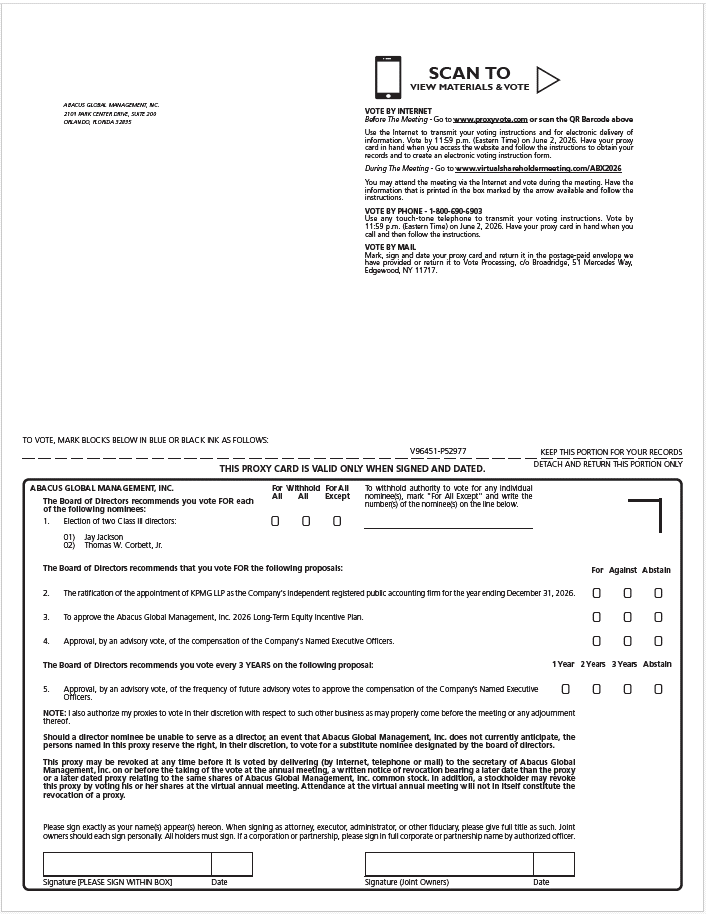
76
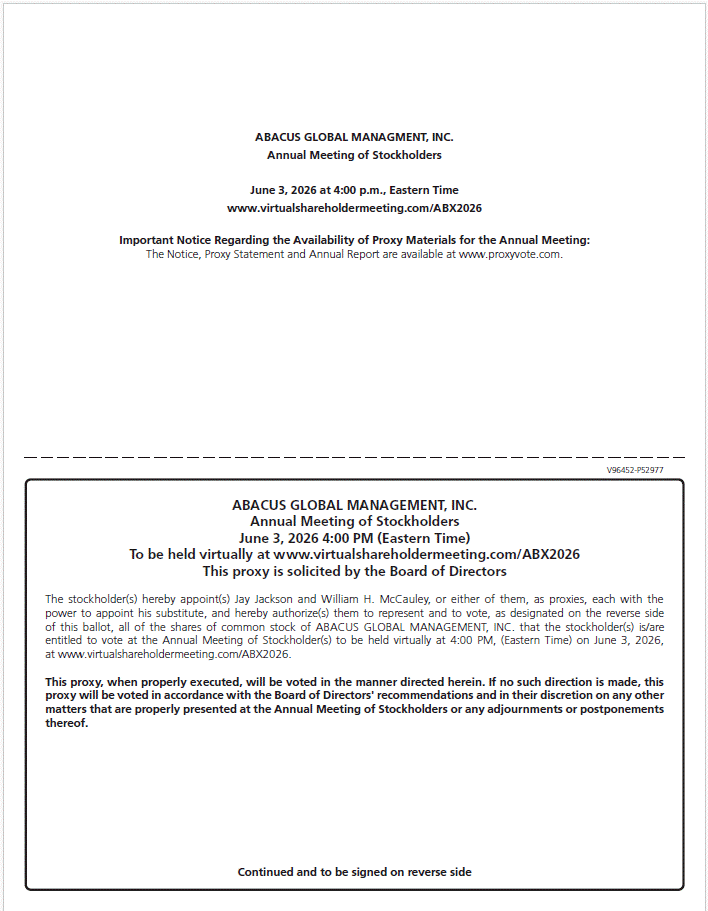
77